The Board
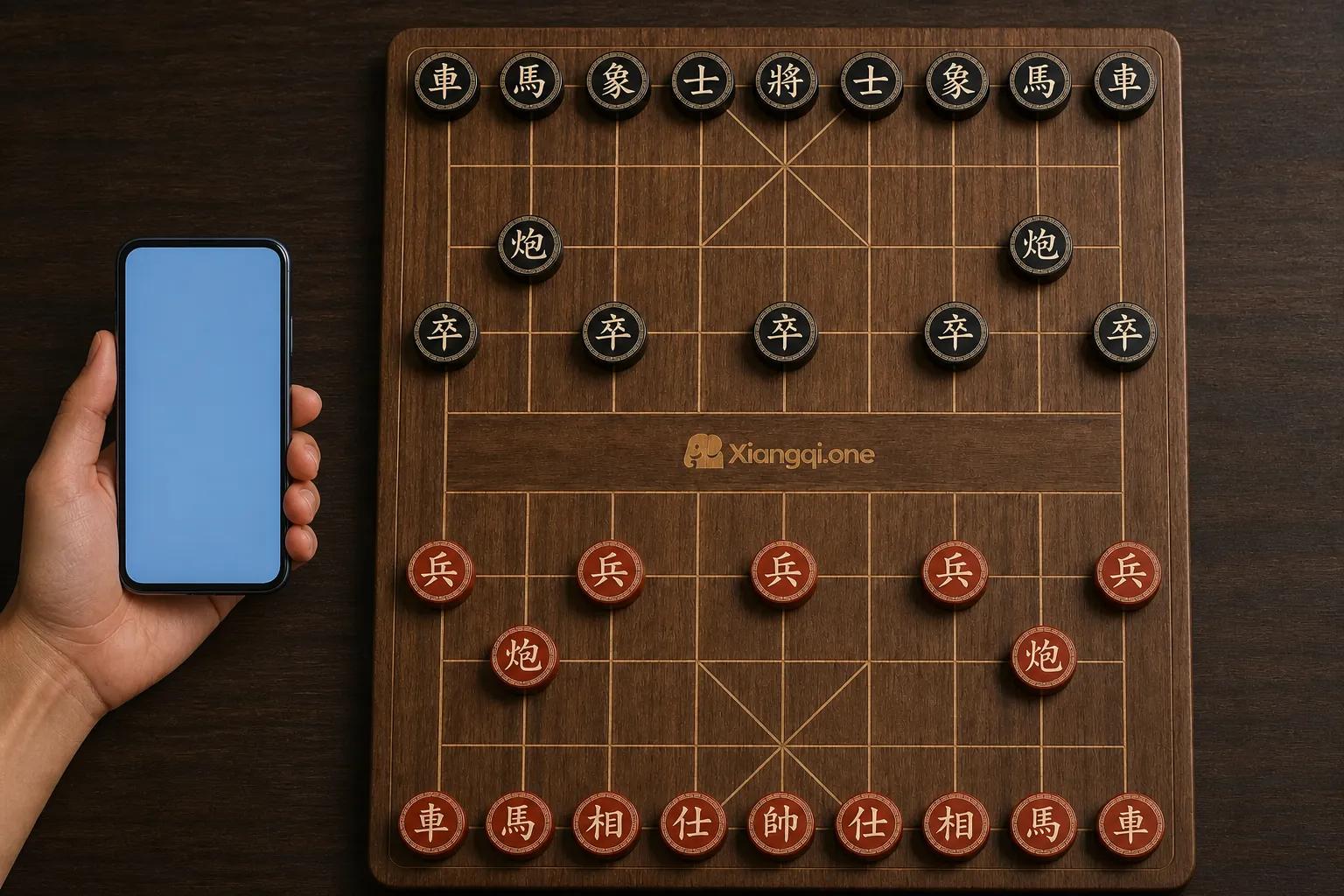
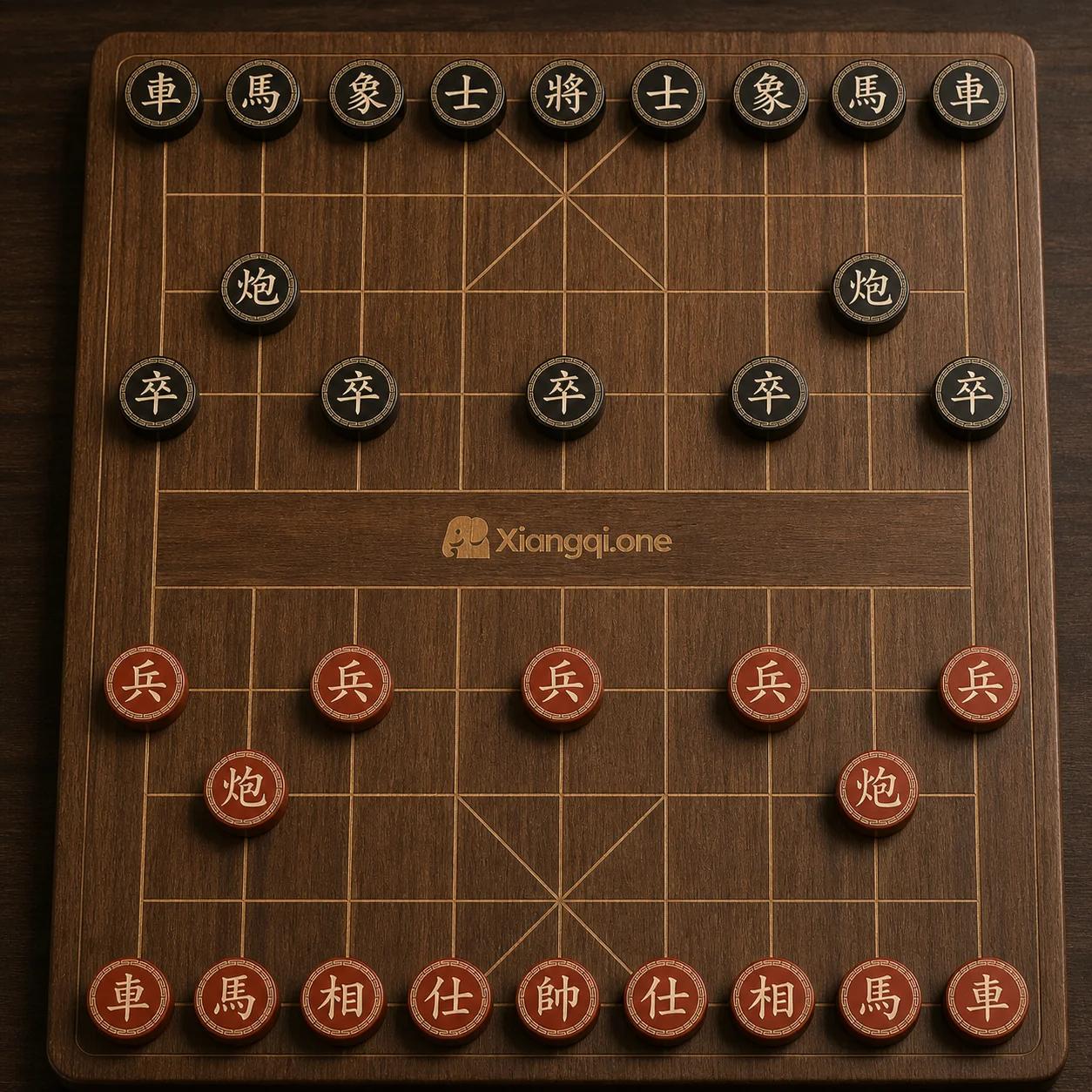
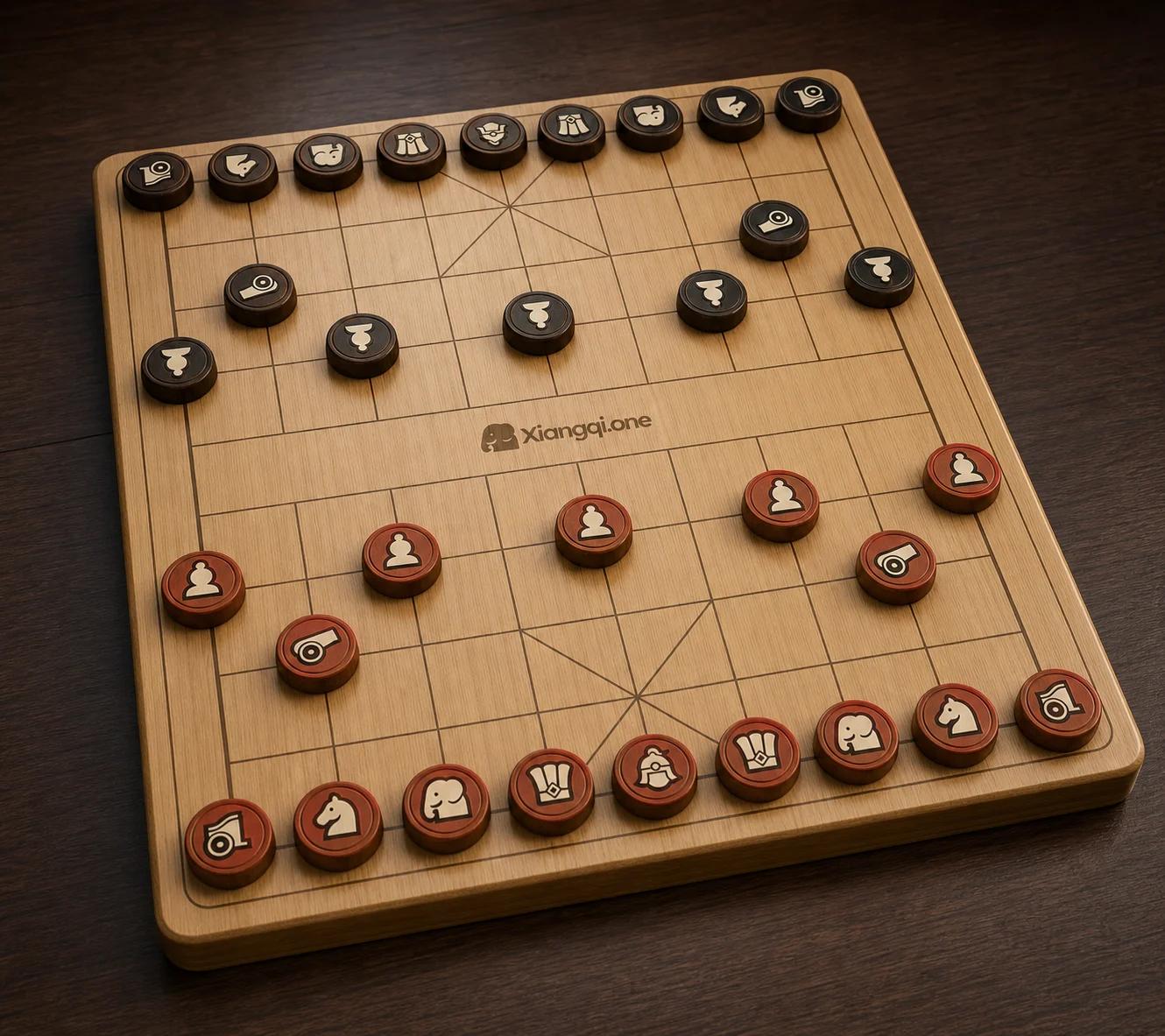
Xiangqi is played on a rectangular board made up of 9 vertical lines and 10 horizontal lines. Unlike Western chess, pieces are placed on the intersections of these lines rather than inside squares. This creates a grid of 90 playable points. The board is divided in half by a horizontal gap called the River. The river affects how certain pieces move: Elephants cannot cross it, while Soldiers gain the ability to move sideways after crossing. On each side of the board, a 3×3 area marked by diagonal lines forms the Palace. The General and Advisors are confined to this area for the entire game.
Setting Up the Pieces
Each player starts with 16 pieces. The two sides are traditionally colored Red and Black, with Red always moving first. The pieces are arranged symmetrically. From your perspective, the back row contains one General in the center, flanked by two Advisors, then two Elephants, then two Horses, and finally two Chariots on the edges. The two Cannons are placed on the third row, two points in from each edge. The five Soldiers are placed on the fourth row, on alternating intersections. Despite having the same roles, Red and Black pieces use different Chinese characters to distinguish them.
The General
The General is the most important piece on the board. If your General is captured or checkmated, you lose the game. The General moves one point at a time, either horizontally or vertically, but is confined to the nine points of the Palace. An important rule is the "flying General" rule: the two Generals may never face each other on the same vertical line with no pieces between them. This rule often plays a critical role in endgame tactics, as it essentially means the General controls the entire file it stands on.
The Advisor
Each side has two Advisors that protect the General. Advisors move exactly one point diagonally and, like the General, are confined to the Palace. This means an Advisor can only ever reach five specific points on the board. While their range is limited, Advisors are essential for defending the General against attacks. They form a protective shield when positioned correctly, and losing both Advisors often makes the General extremely vulnerable.
The Elephant
Each side has two Elephants that move exactly two points diagonally, forming a pattern similar to the Chinese character for "field." Elephants cannot jump over other pieces; if a piece occupies the point between the Elephant's starting and ending positions, the Elephant is blocked. Additionally, Elephants cannot cross the River, restricting them to your own half of the board. This makes Elephants purely defensive pieces, useful for protecting the General and blocking incoming attacks.
The Horse
The Horse moves in an L-shape: one point horizontally or vertically, then one point diagonally outward. This is similar to the Knight in Western chess, but with one crucial difference: the Horse can be blocked. If a piece sits on the point directly adjacent to the Horse in the direction of its first step, the Horse cannot move in that direction. This blocking rule, sometimes called "hobbling the Horse's leg," adds a tactical layer absent from Western chess. In open positions, the Horse is a powerful attacking piece that can reach many points on the board.
The Chariot
The Chariot is the most powerful piece in Xiangqi. It moves any number of points horizontally or vertically in a straight line, identical to the Rook in Western chess. The Chariot cannot jump over other pieces. Due to its long range and unrestricted movement (it can go anywhere on the board), the Chariot dominates both attack and defense. A common saying in Xiangqi is "A Chariot is worth nine points," reflecting its supreme value. Developing your Chariots early is one of the most important strategic principles.
The Cannon
The Cannon is the most unique piece in Xiangqi and has no equivalent in Western chess. It moves like the Chariot, sliding any number of points horizontally or vertically. However, to capture an enemy piece, the Cannon must jump over exactly one piece (called a "screen" or "platform") that sits between it and its target. The screen can be friendly or enemy. This dual nature makes the Cannon a fascinating tactical piece: it is strong in the opening and middlegame when the board is crowded with potential screens, but loses power in the endgame as pieces are traded off.
The Soldier
Each side begins with five Soldiers placed on alternating points. Before crossing the River, a Soldier can only move one point forward. After crossing the River, it gains the ability to also move one point sideways (left or right), but it can never move backward. Soldiers cannot retreat under any circumstances. While individually weak, Soldiers become more valuable after crossing the River. A well-advanced Soldier near the enemy Palace can be surprisingly dangerous, restricting the General's movement and supporting other attacking pieces.
Check, Checkmate, and Stalemate
When a piece directly threatens to capture the enemy General on the next move, the General is said to be "in check." The player whose General is in check must immediately resolve the threat by moving the General, blocking the attack, or capturing the attacking piece. If a player's General is in check and there is no legal move to escape, it is checkmate, and that player loses the game. Unlike Western chess, stalemate in Xiangqi is a loss for the player who cannot move. If you have no legal moves on your turn, you lose. This rule encourages aggressive play and makes endgame technique critically important.
Basic Strategy Tips
Develop your Chariots early: they are your strongest pieces, and leaving them stuck behind other pieces wastes their power. Control the center of the board, especially the central file, as it provides the fastest route to the enemy General. Use your Cannons effectively in the opening while there are many pieces to serve as screens. Protect your General with at least one Advisor and one Elephant when possible. Advance your Soldiers across the River to gain sideways mobility. Coordinate your pieces: a well-timed combination of Chariot, Horse, and Cannon can deliver devastating attacks. For a deeper dive into each piece, read our complete Xiangqi pieces guide. Practice puzzles and study openings to build your tactical vision — check out our openings guide to get started. You can also play Xiangqi online for free on Xiangqi One, which offers puzzles, lessons, and analysis tools to help you progress from beginner to advanced player. For a point-by-point walkthrough of the starting position, including which Chinese character goes on which piece, see our Xiangqi board setup guide.