What Is the Cannon?
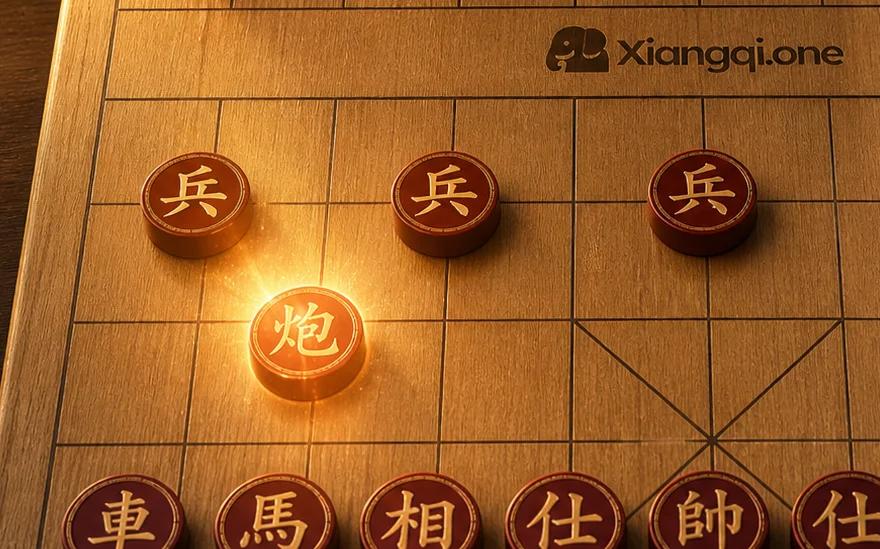
The Cannon (炮/砲, Pao) is Xiangqi's most original piece and has no equivalent in Western chess. Each player starts with two Cannons, placed on the third row of the board. What makes the Cannon special is its unique capture mechanic: it moves like the Chariot (in a straight line), but to capture it must jump over exactly one intervening piece called a screen. This duality between movement and capture makes it a fascinating piece that demands a different kind of tactical thinking than any other piece on the board.
Movement and Capture
The Cannon moves in a straight line, horizontally or vertically, any number of intersections — exactly like the Chariot. However, its capture works completely differently: to take an enemy piece, the Cannon must jump over exactly one piece (friendly or enemy) that sits between it and its target. This intervening piece is called a screen or platform. Without a screen, the Cannon cannot capture even if it has a direct line to the enemy piece. With the right screen, it can strike from great distances. The Cannon cannot jump over pieces to move, only to capture.
The Cannon in the Opening
The Cannon is a dominant piece in the opening, when the board is full of pieces that can serve as screens. The most popular Xiangqi opening, the Central Cannon, involves moving the Cannon to the center of the board where it directly threatens the enemy General. Other popular Cannon openings include the Same Direction Cannon and the Opposite Direction Cannon. In the early phase, Cannons work best in coordination with other pieces, especially Horses, creating complex tactical threats.
The Cannon in the Middlegame
During the middlegame, the Cannon's strength depends on the availability of screens. A well-placed Cannon can control entire lines and create long-range capture threats. Look for positions where your Cannon has access to multiple potential screens. The classic combination is using a Horse or Soldier as a screen to attack the enemy Palace. Keep in mind that your own defensive pieces can also serve as screens for the opponent's Cannon, so the position of every piece has double importance.
The Cannon in the Endgame
As pieces are traded, the Cannon's value decreases significantly. With fewer pieces on the board, finding screens becomes increasingly difficult. A Cannon without a screen cannot capture anything, making it ineffective. For this reason, many experienced players prefer to trade Cannons before the endgame. However, a Cannon with a well-maintained screen can remain dangerous. The combination of Cannon plus crossed Soldier can generate lethal checkmates against a poorly protected General.
Essential Cannon Tactics
The double Cannon is a devastating tactic where two Cannons line up on the same file, using each other as screens. The ambush Cannon hides behind a piece waiting for an attack line to open. The Cannon pin occurs when a piece cannot move because it would expose a more valuable piece behind it to the Cannon's attack. Practice these tactics by solving puzzles on Xiangqi One to develop your tactical vision with this unique piece.
Value and Comparison with Other Pieces
The Cannon is generally valued at 4.5 points, similar to the Horse. However, its value fluctuates more than any other piece during the game. In the opening, when screens are plentiful, the Cannon can be worth more than the Horse. In the endgame, with few pieces on the board, it is usually worth less. This fluctuation makes knowing when to trade a Cannon for a Horse a key strategic skill. Check our pieces guide for a complete comparison of piece values.