What Are Advisors and Elephants?
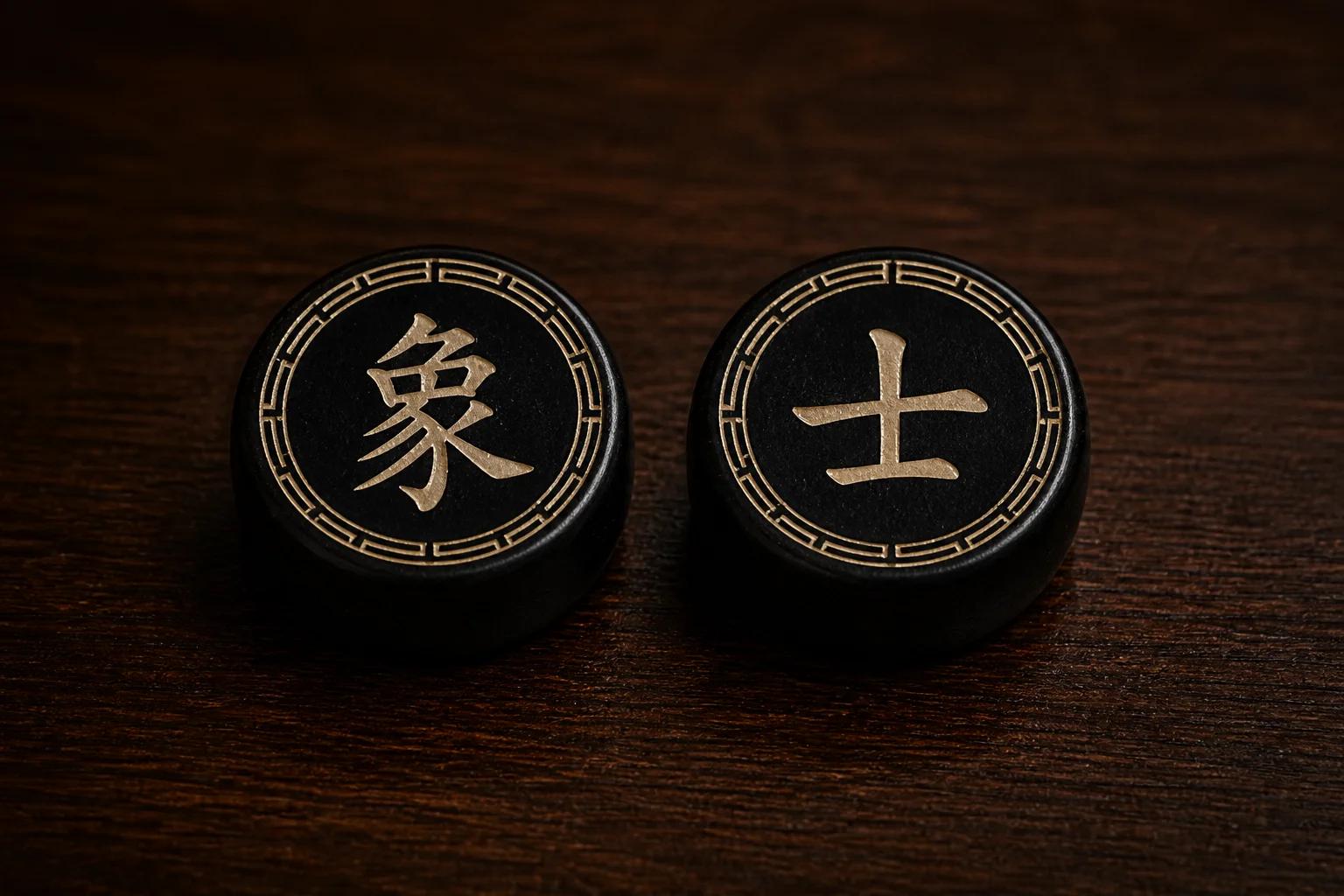
In Xiangqi, every player starts with two Advisors (仕/士, Shi) and two Elephants (相/象, Xiang). These are purely defensive pieces whose primary job is to protect the General inside the Palace. Unlike major attacking pieces such as the Chariot or Cannon, Advisors and Elephants are confined to specific areas of the board and cannot cross the river. Their restricted movement might seem like a weakness, but it is actually what makes them so effective at defense: they stay close to the General and form a protective shield that is difficult to penetrate.
How the Advisor Moves
The Advisor moves exactly one point diagonally and is confined to the nine-intersection Palace (the 3x3 grid surrounding the General). This means the Advisor can only ever occupy five positions: the four corners of the Palace and the center point. Despite this limited range, the Advisor is a critical defensive piece. A single Advisor sitting in the center of the Palace blocks diagonal attacks, while Advisors on corner points protect the General from lateral threats. Two Advisors working together can cover all diagonal approaches to the General, making checkmate significantly harder for the opponent to achieve.
How the Elephant Moves
The Elephant moves exactly two points diagonally, tracing a path that resembles the Chinese character for 'field' (田). This gives it a larger range than the Advisor, but it comes with two important restrictions. First, the Elephant cannot cross the river, so it is limited to your own half of the board. Second, if a piece occupies the intersection between the Elephant's starting point and its destination (the center of the 'field'), the Elephant is blocked and cannot complete the move. This blocking rule is a common source of tactical tricks, so always check for obstructions before planning an Elephant move.
Defensive Formations: Full Guard vs. Partial Guard
A full defensive formation means having both Advisors and both Elephants intact, creating a layered shield around your General. This setup is extremely resilient and can withstand attacks from multiple pieces. However, as the game progresses, you may lose one or more defensive pieces through trades or sacrifices. A partial guard with one Advisor and one Elephant is still functional but leaves vulnerabilities that a skilled opponent will exploit. Understanding which formations are safe and which are dangerous is a core skill covered in our beginner mistakes guide. As a general rule, try to keep at least one Advisor and one Elephant for as long as possible.
When to Sacrifice an Advisor or Elephant
Although Advisors and Elephants are defensive pieces, there are situations where sacrificing one is the correct decision. If your opponent is launching a strong attack, giving up an Advisor to capture a threatening Cannon or break an attacking formation can be worth the material loss. Similarly, sacrificing an Elephant to gain a tempo or clear a blocking piece for your counterattack can turn the tide. The key is to evaluate the trade carefully: losing a defensive piece valued at roughly 2 points is acceptable if it eliminates a threat worth more or creates a winning attack. In the endgame, a single Advisor or Elephant can sometimes be sacrificed to force a stalemate draw from a losing position.
Common Defensive Mistakes
One of the most frequent errors is moving an Advisor or Elephant away from the General without good reason, leaving the Palace exposed. Another common mistake is failing to notice that an Elephant is blocked: players sometimes assume their Elephant can move when a piece is sitting on the blocking point. Beginners also tend to undervalue these pieces, trading them casually in the opening for no strategic benefit. Remember that each Advisor or Elephant you lose weakens your Palace defense permanently. Finally, placing both Advisors on the same diagonal creates a weakness that Cannons can exploit by using one Advisor as a screen to capture the other. Review more pitfalls in our beginner mistakes article.
Coordination with Other Pieces
Advisors and Elephants are strongest when they work together with other pieces. A General flanked by two Advisors and supported by an Elephant on the wing creates a fortress that can absorb heavy pressure. Horses retreating to defensive positions near the Palace combine well with Advisors to cover each other's blind spots. A Cannon placed behind your own defensive pieces can use them as screens for counterattacks. Even a crossed Soldier returning to defend can reinforce the Palace structure. For a full overview of how every piece works, see the complete pieces guide. Practice these defensive setups by playing games on Xiangqi One and focusing on keeping your Palace solid throughout the middlegame.