How does the General move?
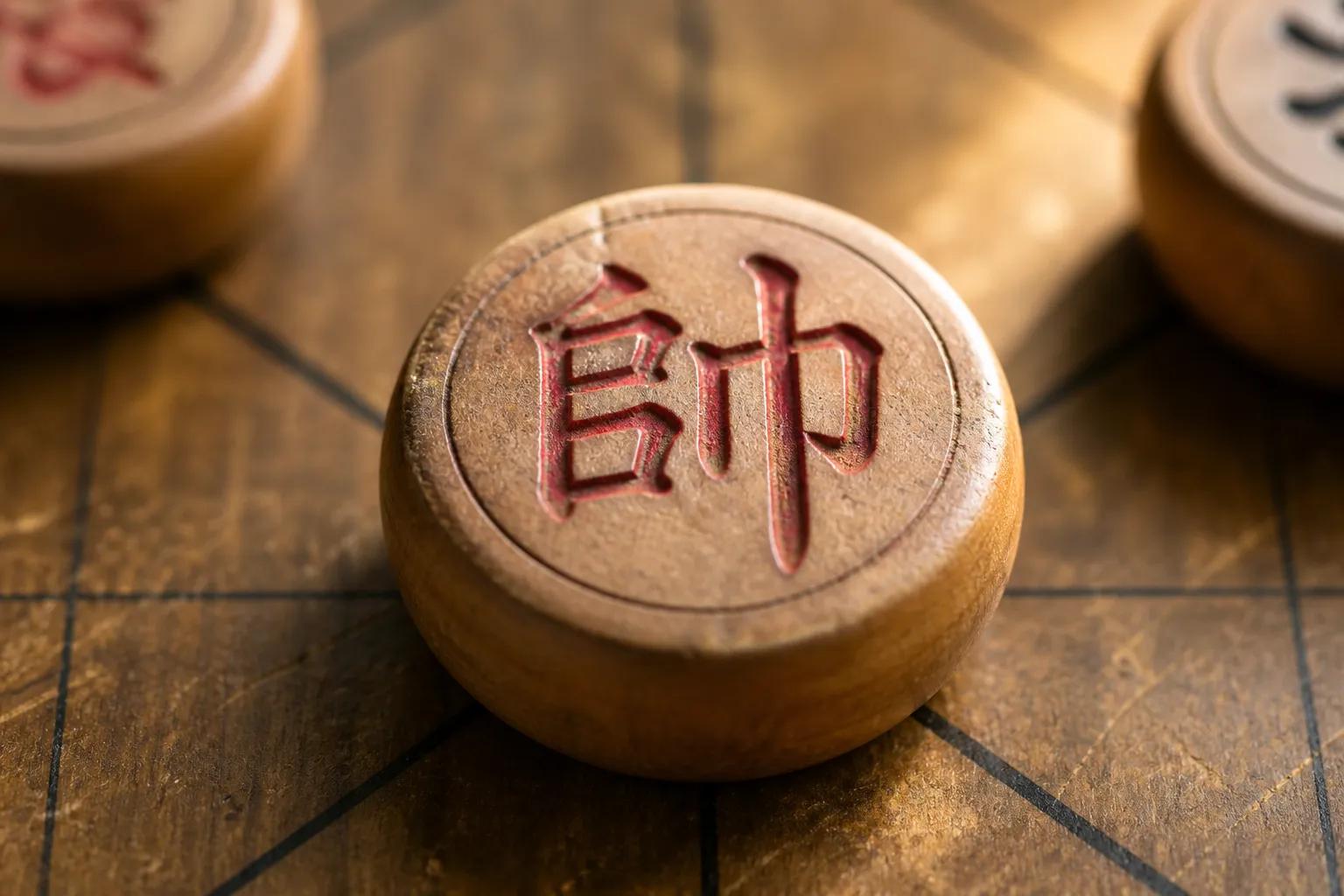
The General — 帥 for Red, 將 for Black — moves exactly one point at a time, horizontally or vertically. It never moves diagonally, which already sets it apart from the chess king. The far more important restriction is spatial: the General is confined to the palace, the three-by-three square marked with diagonal lines at each end of the board. It has nine squares to live in and never leaves them, for the entire game. That confinement changes everything about how the piece is defended and attacked. In chess, a king can run toward a corner, castle away from danger, or walk up the board in the endgame. A Xiangqi General has none of those escapes: it can only shuffle within nine points, which means an attacker who controls those nine points has effectively won. Everything else in this guide follows from that single fact. If you are still learning the other pieces, our complete guide to the Xiangqi pieces covers each one in turn.
What is the flying general rule?
This is the rule that surprises every newcomer: the two Generals may never face each other along an open file. If the two palaces line up on the same column and there is no piece at all between the Generals, the position is illegal. In practice this means you may not play a move that leaves the Generals staring at each other, and if your opponent's move would create that situation, it is simply not a legal move. The usual mental image is that a General would fly down the empty file and capture its counterpart, which is why the rule is often called the flying general. What matters is not the imagery but the consequence: an empty file between the palaces is a live threat, permanently. A defender cannot step aside onto a file where the enemy General waits, and an attacker can create winning threats simply by clearing a column. Beginners treat this as a curiosity. Strong players treat it as a weapon, and the next sections show how.
How is the flying general rule used to win?
Two ways, and both are worth drilling. The first is as a mating resource: if you can clear the file between the two palaces at the right moment, the enemy General suddenly has one fewer square to run to, because stepping onto that file would be illegal. Many mates that look impossible become forced once you notice that the defending General cannot use the open column. The second is as a pin: a defending piece sitting on the file between the Generals often cannot move at all, because vacating the file would expose the illegal facing position. That piece is frozen exactly like a pinned piece in chess, and you can attack it a second time knowing it cannot run. Combining the two is where games are won — clear the file with a sacrifice, freeze the defender, then deliver mate. These motifs appear constantly in endgames, which our guide to Xiangqi endgame basics develops further.
How do you keep the General safe in the opening?
The short answer is: leave it alone. In the opening the General has almost nothing useful to do, and every move it makes tends to weaken something. The real work of king safety is done by the Advisors and Elephants, which exist almost entirely to shield the palace — our guide to the Advisors and Elephants explains their defensive geometry in detail. Two habits matter most. First, be very reluctant to trade away both Advisors, because a palace missing its Advisors is dramatically easier to mate, especially against Chariots and Cannons. Second, watch the central file, since the classic central cannon attack aims directly at the point in front of your General — the reasoning is laid out in our article on the central cannon opening. Moving the General early to break a pin is occasionally necessary, but it should feel like a concession, not a plan.
When should the General become active?
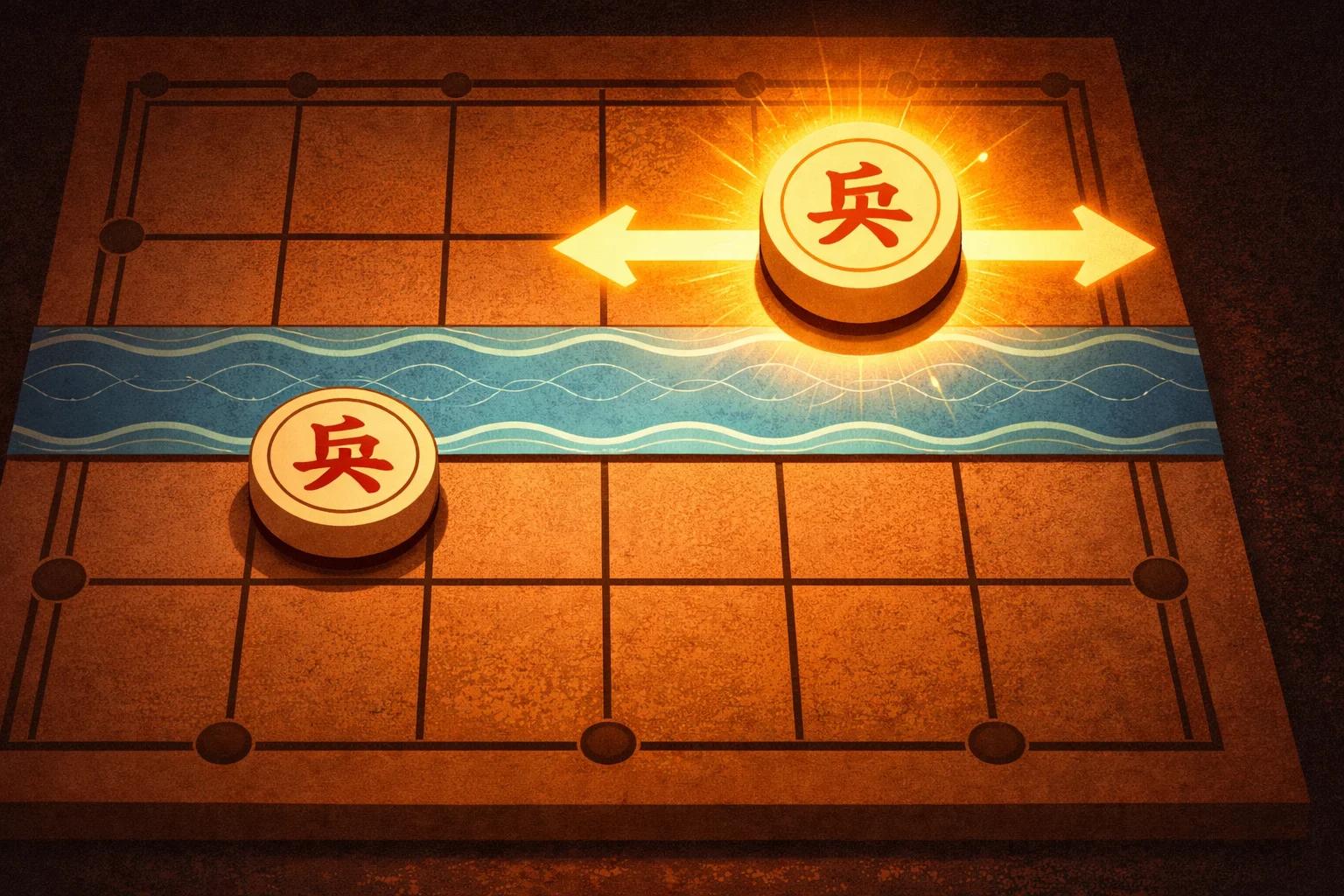
In the endgame, and more often than beginners think. Once most attacking pieces are off the board, the General stops being purely a liability and becomes a defender that works: it can guard a point in the palace that an Advisor cannot reach, it can shoulder the enemy General to control the facing file, and it can support a Soldier that has crossed the river. The classic pattern is using your own General to hold the opposing General on a specific file, taking squares away without moving a single other piece. This is the closest Xiangqi equivalent to opposition in chess endgames, and it decides many otherwise balanced positions. The limitation never goes away — the General still cannot leave the palace, so its activity is always local. But within those nine points, a well-placed General is worth a tempo in almost every endgame. Our Chariot versus Horse endgame guide shows several positions where exactly this decides the result.
What are the most common mistakes with the General?
Three, in order of how often they cost games. The first is stripping the palace — trading Advisors and Elephants for material or activity without counting how exposed the General becomes. A single Chariot against a stripped palace is often already winning. The second is forgetting the facing rule while calculating, in both directions: players miss that their own escape square is illegal, and equally often miss that an opponent's defensive piece is frozen on the facing file. If a variation ends with your General on the same column as your opponent's, recheck it before trusting the whole line. The third is panicking early, moving the General on the first check instead of blocking or capturing. Each General move burns a tempo and usually degrades the palace structure. Our article on common beginner mistakes covers these alongside the other habits that hold players back.
Which mating patterns should you know?
A handful of patterns account for the majority of decisive games. The Chariot mate on the back rank is the most basic: a Chariot delivering check along the bottom line against a General with no escape squares, usually after the Advisors are gone. The Cannon mate, where the Cannon checks from a distance using a screen piece while a second attacker covers the escape squares, is the most characteristic of Xiangqi, and there is no chess equivalent to build intuition from — our complete guide to the Cannon explains the screen mechanics that make it work. The Horse mate exploits the fact that a General confined to nine points cannot easily escape a piece attacking two of them at once. And overlaying all of these, the facing-Generals restriction removes escape squares for free. Learn to see all four at once rather than as separate tricks: real mates almost always combine two of them.
How does the General differ from the chess king?
Enough that chess intuition actively misleads you here. The chess king moves in all eight directions and roams the whole board; the Xiangqi General moves in four and never leaves nine points. There is no castling in Xiangqi, so there is no moment where you tuck the General away and forget about it — palace safety is managed continuously, with Advisors and Elephants, from move one. There is no facing rule in chess, so the single most useful attacking resource in Xiangqi has no counterpart to transfer from. And critically, stalemate is not a draw in Xiangqi: a player with no legal move loses, where in chess it saves the game. That last difference reverses the value of many endgame positions, and our article on special rules and draws covers it along with the perpetual-check rules. If you come from chess, our guide for chess players maps the rest of these differences.
Practising General safety and mating patterns
The fastest way to internalise all of this is to play out endgames where only a few pieces remain, because that is where the General's confinement and the facing rule dominate every decision. Set up a Chariot against a palace with and without Advisors and see how the evaluation swings; then do the same with a Cannon, which needs a screen and behaves completely differently. Playing against a calibrated opponent helps more than reading about it: pick a difficulty where you lose roughly a third of your games, which is the range where mistakes are frequent enough to learn from but not so frequent that nothing is instructive. To practise right now against an opponent at your level, open Xiangqi One. For the broader picture of how the pieces work together, continue with our complete guide to the Xiangqi pieces, or browse the pieces category. If you are still unsure where each piece begins, our Chinese chess board setup guide walks through the starting position point by point.