Board Size and Layout
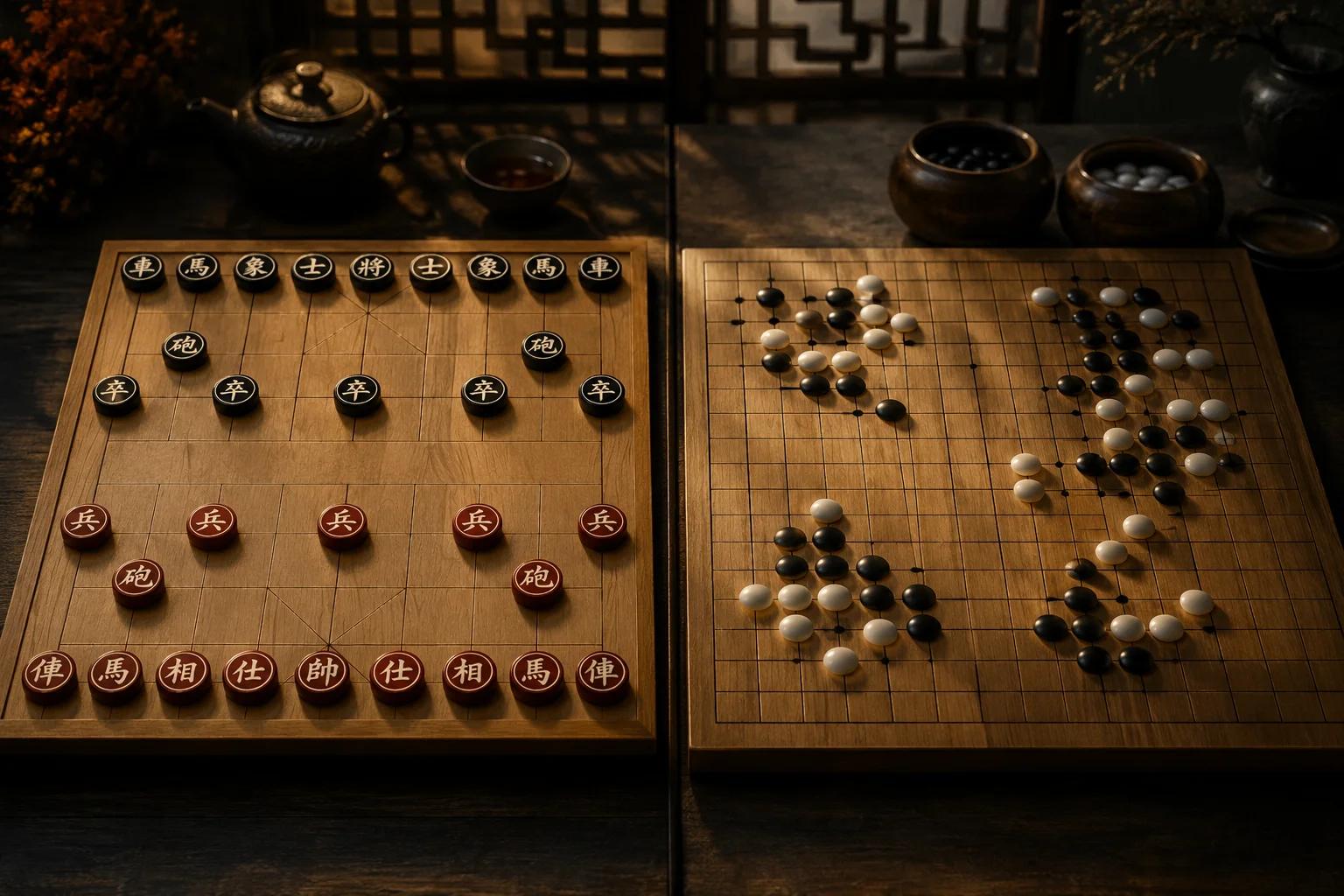
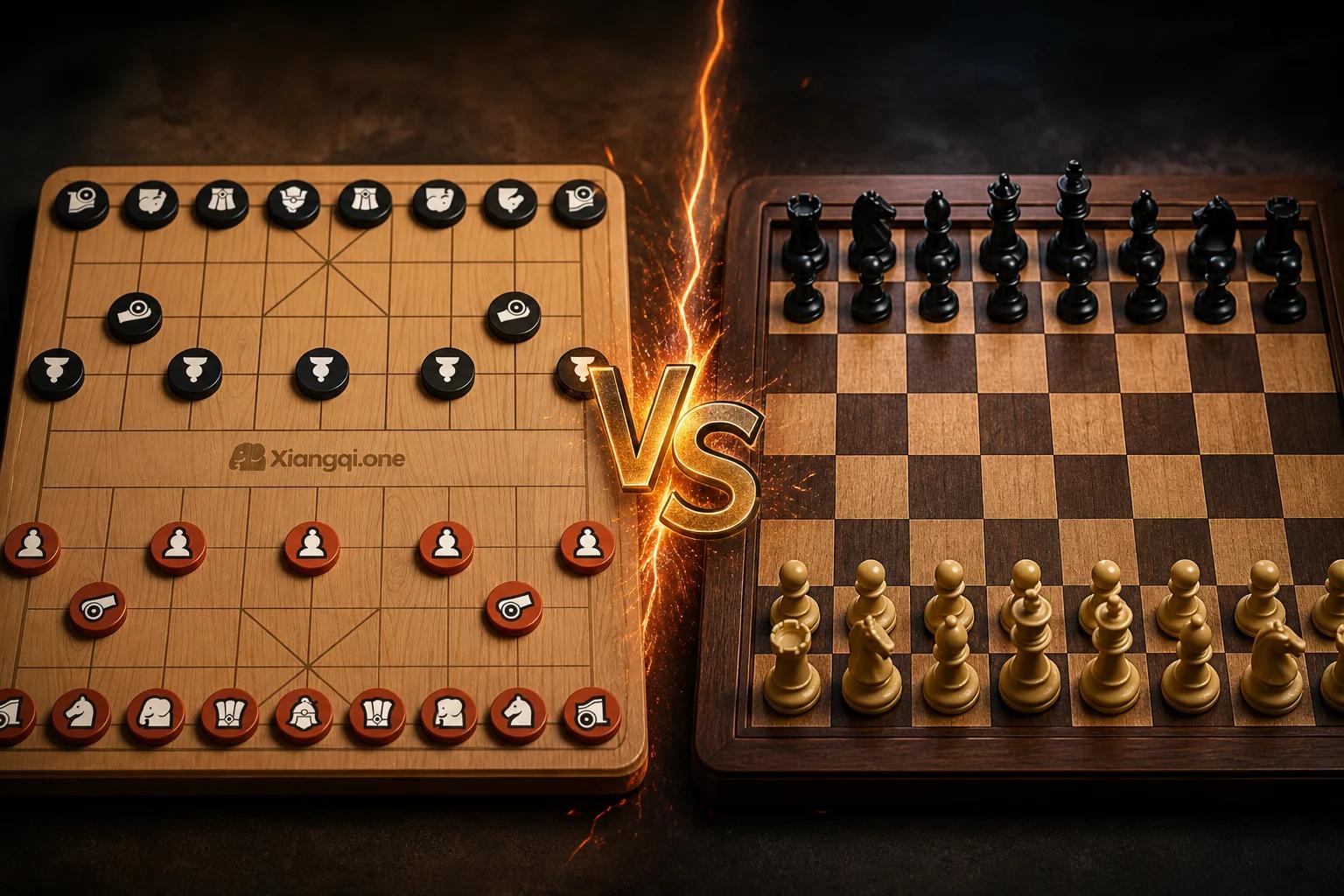
The most visible difference between Xiangqi and Western chess is the board itself. Western chess uses an 8×8 grid of 64 alternating light and dark squares, with pieces placed inside the squares. Xiangqi uses a larger 9×10 grid of lines, creating 90 intersection points where pieces are placed. The Xiangqi board also features two unique zones absent from Western chess: the River, a horizontal gap dividing the board in half, and two Palaces, 3×3 areas marked with diagonal lines on each side. These zones restrict certain pieces and create gameplay dynamics that have no equivalent in Western chess.
The River Changes Everything
The River in Xiangqi is not just a visual element; it fundamentally alters how several pieces behave. Elephants cannot cross the River at all, confining them to their own half of the board as purely defensive pieces. Soldiers gain sideways movement after crossing the River, transforming from limited forward-only pieces into more versatile attackers. No piece in Western chess changes its movement rules based on its position on the board, making the River a truly unique Xiangqi mechanic that adds a layer of positional strategy not found in its Western counterpart.
The Palace Restriction
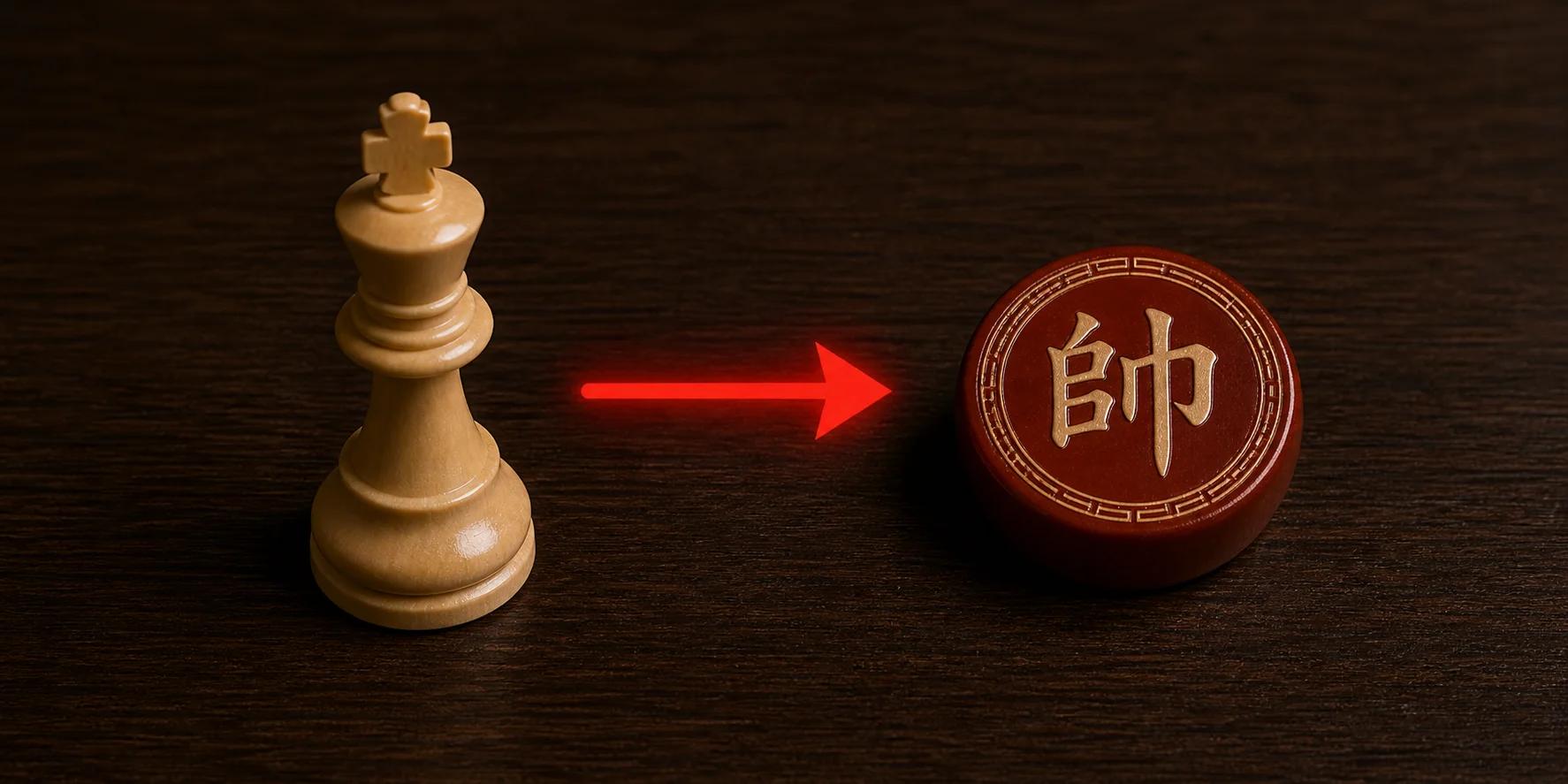
In Xiangqi, the General (equivalent to the King) and the two Advisors are permanently confined to a 3×3 Palace zone. This means the General can only ever occupy nine possible points, compared to the Western King which can roam the entire board. This restriction makes attacking the General a very different challenge. Instead of chasing a King across the board, attackers must penetrate the Palace defenses. The confined space also means that smothered mates and palace-based tactical patterns are a major part of Xiangqi endgame technique.
The Cannon: A Piece with No Western Equivalent
Perhaps the single most distinctive element of Xiangqi is the Cannon. It moves identically to the Chariot (Rook), sliding any number of points in a straight line. However, to capture, the Cannon must jump over exactly one intervening piece, called a screen. This dual movement and capture mechanic has no equivalent in Western chess or any other major chess variant. The Cannon is powerful in the opening when the board is full of potential screens, but weakens in the endgame as pieces are traded. This dynamic creates a fundamentally different tempo and piece-value curve compared to Western chess.
The Horse Can Be Blocked
Both games feature a piece that moves in an L-shape: the Horse in Xiangqi and the Knight in Western chess. However, there is a critical difference. The Western Knight can jump over any pieces in its path and cannot be blocked. The Xiangqi Horse, by contrast, can be blocked if a piece occupies the adjacent point in the direction of its first step. This blocking rule, known as "hobbling the Horse's leg," means that piece placement around the Horse matters far more in Xiangqi. A Horse surrounded by pieces is nearly useless, while a Knight in the same situation in Western chess remains fully functional.
Piece Placement: Intersections vs Squares
This seemingly minor difference has a significant impact on how the games feel. In Western chess, pieces sit in the center of squares, and movement follows square-to-square logic. In Xiangqi, pieces sit on the intersections of lines, and movement follows the lines themselves. This means Xiangqi pieces visually relate to each other through the grid lines, and concepts like "controlling a line" or "blocking a file" take on a more literal, visual meaning. For players transitioning between the two games, this difference in spatial reasoning is often the hardest adjustment.
No Piece Promotion
In Western chess, a Pawn that reaches the opponent's back rank is promoted to any other piece, usually a Queen. This promotion mechanic creates powerful endgame dynamics and motivates Pawn advancement. Xiangqi has no promotion whatsoever. A Soldier that crosses the River gains sideways movement but never transforms into a stronger piece. This means endgames in Xiangqi play out very differently. There is no hope of converting a material advantage into a new powerful piece, so piece preservation and careful endgame technique matter even more.
Stalemate Is a Loss, Not a Draw
One of the most impactful rule differences between the two games involves stalemate. In Western chess, if a player has no legal moves and is not in check, the game is a draw. This rule often allows a losing player to escape with a draw through defensive technique. In Xiangqi, stalemate is a loss for the player who cannot move. This single rule difference profoundly affects strategy. It encourages aggressive play, makes defensive fortresses less viable, and means that having even a slight material advantage in the endgame is often enough to win. Players cannot simply blockade the position and hope for a draw.
The Flying General Rule
Xiangqi has a unique rule with no equivalent in Western chess: the two Generals may never face each other on the same file with no pieces between them. This seemingly simple restriction has far-reaching tactical implications. In the endgame, the General effectively controls the entire file it stands on, acting as an invisible barrier. This rule creates endgame tactics and checkmate patterns that are entirely absent from Western chess, and mastering it is essential for advanced Xiangqi play. It also prevents certain defensive setups that would otherwise be possible.
Speed and Tactical Nature
Xiangqi games tend to be more tactically sharp and faster-paced than Western chess. The open board, the powerful Chariots that can sweep across long distances, and the Cannon's ability to attack from range all contribute to a game where threats develop quickly. The average Xiangqi game is shorter than a Western chess game at comparable levels. Piece exchanges happen more frequently, and attacks on the General can materialize suddenly. This tactical intensity makes Xiangqi an exciting game for players who enjoy sharp, dynamic positions over slow positional maneuvering.
Which Game Should You Learn?
Both games are deeply strategic, intellectually rewarding, and have thriving global communities. If you already play Western chess, learning Xiangqi will expand your strategic thinking in new directions. The Cannon, the River, the Palace restrictions, and the stalemate rule all create puzzles and patterns that will challenge your chess intuition in exciting ways. If you are new to board games entirely, Xiangqi is an excellent choice, with centuries of strategy literature and a community of hundreds of millions of players. Xiangqi One makes it easy to learn and practice with puzzles, lessons, bot opponents, and online matchmaking. Want to learn the basics? Check our how to play guide or dive into piece strategies.