Two Chinese games, two philosophies
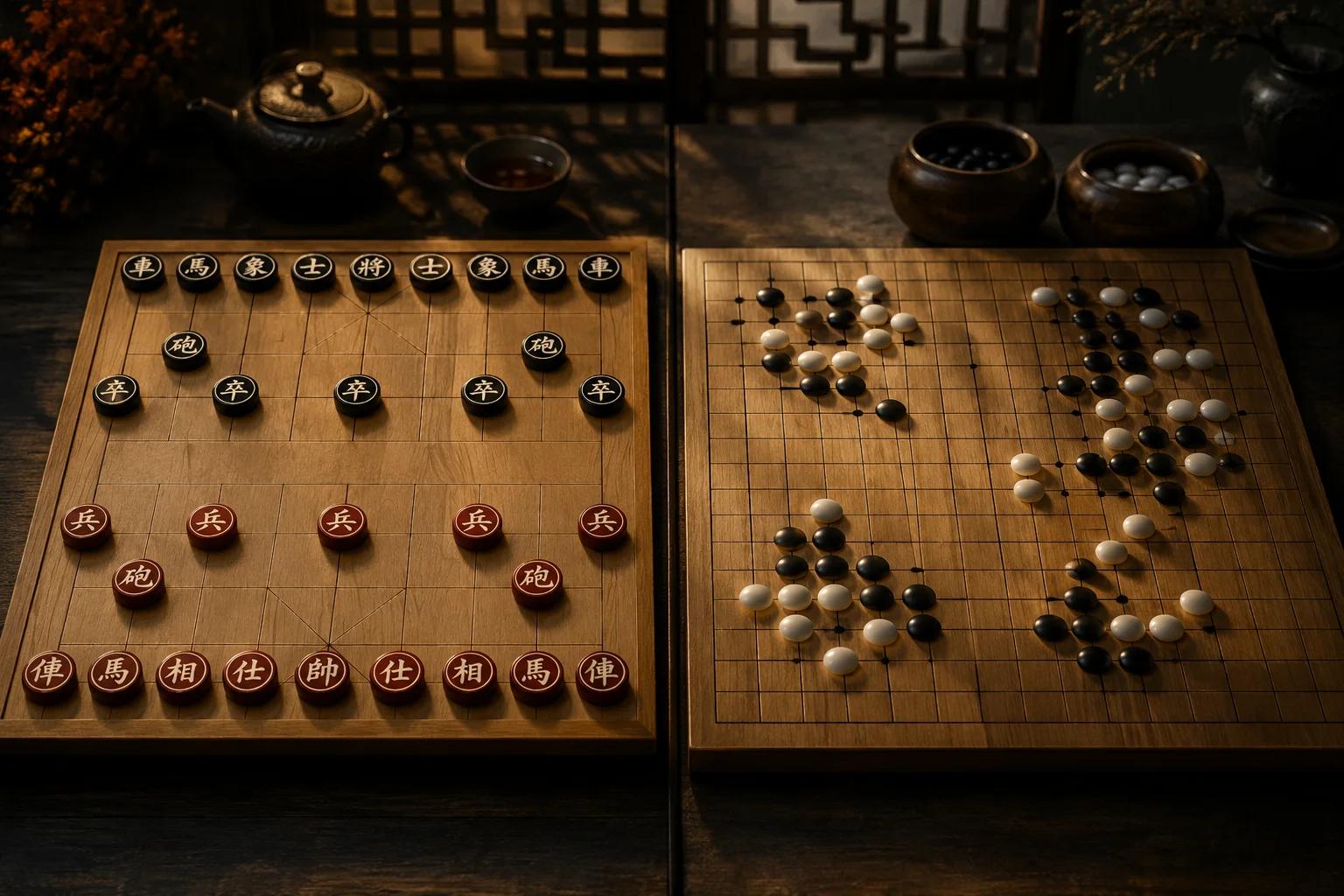
Xiangqi (象棋, "Chinese chess") and Go (围棋, Wéiqí in Mandarin, "the encircling game") are the two most iconic abstract strategy games in Chinese culture. Yet their philosophies are nearly opposite. Xiangqi is a war game: two armies face off with pieces of defined movement, and the goal is to capture the opposing General. Go is a territory game: players take turns placing identical stones on the intersections of an empty board, aiming to surround the largest area. Where Xiangqi stages a concrete military conflict, Go embodies a more abstract metaphor — growth, influence, and mutual pressure. This founding difference explains almost every other divergence, and is what makes the comparison between these two Chinese traditions so rich.
What is the origin of each game?
Go is by far the older of the two. Tradition attributes it to the legendary Emperor Yao, said to have invented it more than 4,000 years ago to teach his son — a legend, of course, but one that reflects the game's deep cultural roots. Solid historical records go back over 2,500 years, making Go probably the oldest board game still played in essentially its original form — its history and rules are covered extensively on the Go (game) Wikipedia page. Xiangqi is significantly more recent. Its roots trace to Indian Chaturanga in the 6th century, which traveled to China via the Silk Road and was gradually transformed. The modern form of Xiangqi, with its river, palaces, and cannon, stabilized around the Song dynasty (960–1279), roughly a thousand years ago. For the full story, see our history of Xiangqi. So Go is "the sage" and Xiangqi "the strategist" — one has been meditating for three millennia, the other has been waging battle for one.
Board and pieces: combat versus territory
The visual difference is immediate. The Go board, the goban, is a 19×19 grid forming 361 intersections, completely empty at the start. Stones are identical (black or white), placed one at a time on the intersections, and never move — once placed, a stone stays unless it is captured by encirclement. The Xiangqi board is smaller (9×10 lines, 90 intersections) but populated from the start with sixteen pieces per side, each different. Every piece has its own movement: the Chariot slides in straight lines, the Horse leaps in an L, the Cannon fires by jumping over a screen, the Elephant cannot cross the river, the Advisors stay inside the Palace. In Go, everything must be built; in Xiangqi, everything is already in place and you must learn to maneuver. To understand Xiangqi pieces in detail, see our pieces guide.
Xiangqi or Go: which is more complex?
These estimates are broad approximations, to be handled with care. The number of possible games in Xiangqi is generally estimated around 10^150, and in Go around 10^170 — figures drawn from academic work on game-tree complexity (notably by Allis and Tromp) — note that state-space complexity, the number of legal positions, is a different and lower figure for both games. By these estimates, Go is combinatorially more complex, which is why it long stood as the "Holy Grail" of artificial intelligence. On each turn, a Go player chooses from about 250 legal moves versus roughly forty in Xiangqi, and a Go game often exceeds 200 moves. That said, combinatorial complexity does not mean "harder to learn": Xiangqi has more numerous and nuanced rules, while Go has only three fundamental rules but abyssal strategic depth. Both games, in their own way, are inexhaustible.
Learning curve: what to expect from each
Xiangqi has a longer onboarding but a clearer trajectory. You need to memorize the movement of seven types of pieces, understand the constraints (river, palace, generals that cannot face each other), and absorb special rules such as the prohibition on threefold repetition. Once these fundamentals are in place, tactical progress comes quickly — see our strategies for beginners. Go, by contrast, exposes its rules in fifteen minutes: place a stone, encirclement captures, and you cannot play a move that recreates the previous position (the ko rule). But this minimalism hides a strategic jungle. Recognizing a living shape, reading a fight dozens of moves deep, evaluating the influence of a wall: these skills take years to mature. The proverb says it takes "three days to learn Go, and a lifetime to master it." For Xiangqi, it's more like "three months to learn, and a lifetime to master."
Cultural prestige: the Four Arts of the scholar
In classical Chinese culture, Xiangqi and Go do not occupy the same rank. Confucianism recognizes the Four Arts (sì yì 四艺) that every scholar was expected to cultivate: the zither (qín 琴), the game (qí 棋), calligraphy (shū 书), and painting (huà 画). The "qí" in question is Go, not Xiangqi. For centuries, Go was the game of the scholar, the Buddhist monk, the imperial official. Xiangqi, meanwhile, remained more of a popular game — played in parks, teahouses, and markets. This cultural split still holds today in China: you see Xiangqi played spontaneously on street corners, while Go retains a more intellectual aura. That said, Xiangqi is vastly more played in absolute numbers across China, Vietnam, and Southeast Asia. Our article on Xiangqi in Chinese culture explores this social anchoring.
Have machines "solved" these games?
Neither Go nor Xiangqi has been mathematically solved — the search tree is far too large. But both have seen artificial intelligence surpass the best human players. The historic moment for Go was March 2016, when DeepMind's AlphaGo defeated champion Lee Sedol 4-1 in Seoul. That victory marked a turning point for deep learning: it had been widely believed that another decade would pass before a machine could master Go at the professional level. The Xiangqi equivalent is Pikafish, an open-source engine derived from Stockfish, now well beyond the best human players and used as a reference for analysis. See our comparison of Xiangqi AI engines. In both cases, machines did not kill the games — on the contrary, they enriched them by revealing ideas humans now exploit in competition.
Which should you learn first?
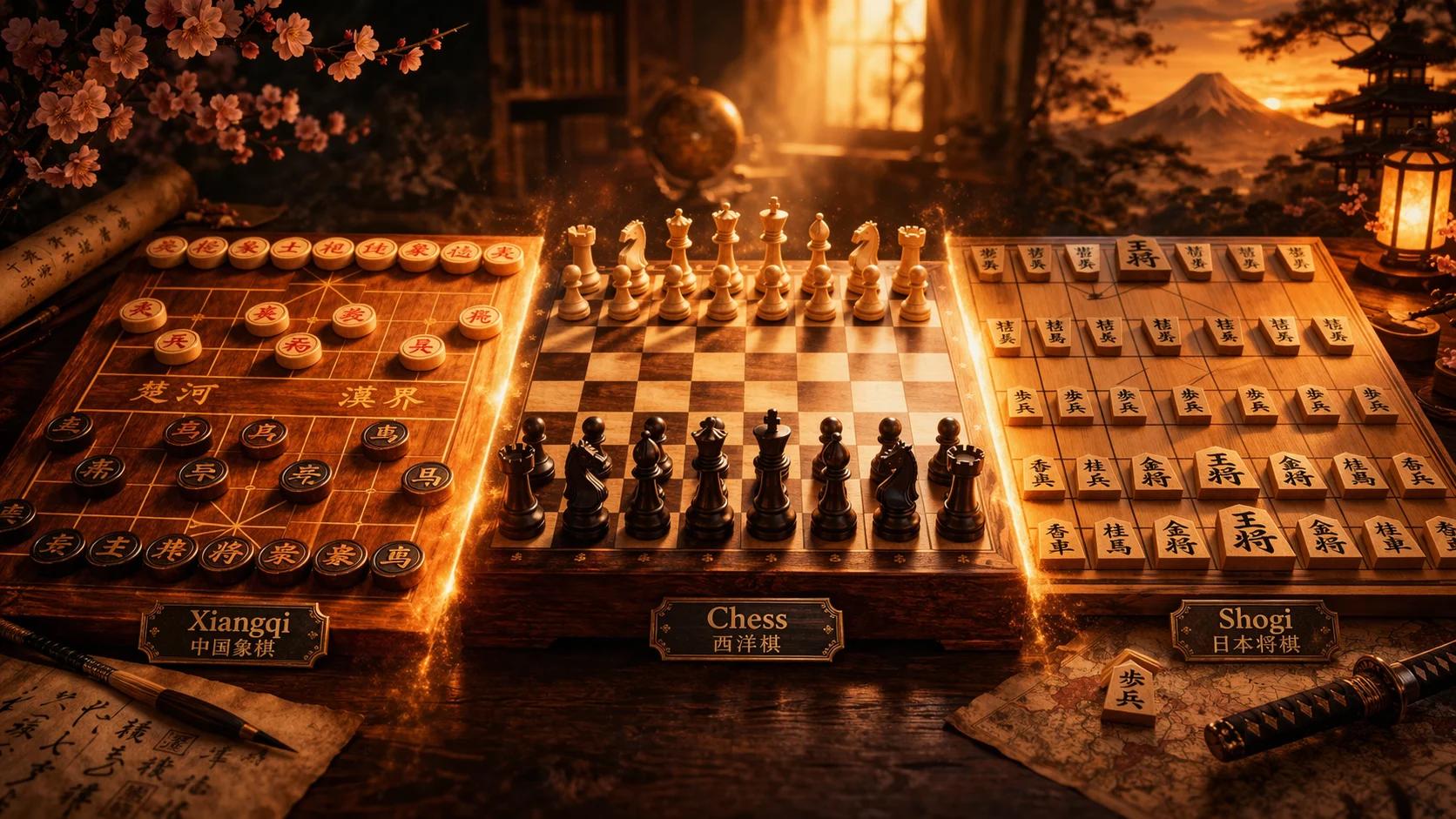
It depends on your profile. If you come from Western chess, Xiangqi will be the more natural transition: the logic is still that of a war game with differentiated pieces, and your tactical instincts (pins, forks, sacrifices) partially transfer. You can also consult our Xiangqi vs Shogi vs chess comparison to place Xiangqi within the chess family. If, on the other hand, you want a radically new experience where none of your chess reflexes apply, Go offers a complete reset — you will have to learn to think in terms of influence, territory, and efficiency rather than direct threats. Many serious players end up practicing both, alternating, because the two games exercise different faculties. Xiangqi sharpens concrete calculation and tactical reading; Go develops spatial intuition and long-term vision.
Two games, one lifetime is not enough
Xiangqi and Go are two treasures of Chinese strategic thought, and pitting one against the other is a bit like pitting music against painting: they aim at the same goal — disciplining the mind through the beauty of a deep game — but take opposite paths. Xiangqi, with its lively pieces, theoretical openings, and sharp endgames, delivers an immediate satisfaction and a sense of combat. Go, with its silent stones and slowly emerging shapes, demands patience and offers a more contemplative satisfaction. If Xiangqi tempts you, Xiangqi One lets you start right now with tactical puzzles, interactive lessons, bot opponents at every level, and online matchmaking. And if you are still hesitating, read our complete guide to learning Xiangqi before you dive in.