Why Do Players Disagree on This?
"Which is harder, Xiangqi or Chess?" is one of the most debated questions in the strategy game world. Western chess players tend to think their game is more complex, while Xiangqi players argue the opposite. The reality is more nuanced: both games have areas where they are more complex than the other. Rather than declaring a winner, this guide honestly compares the different dimensions of complexity so you can form your own opinion.
Board Complexity
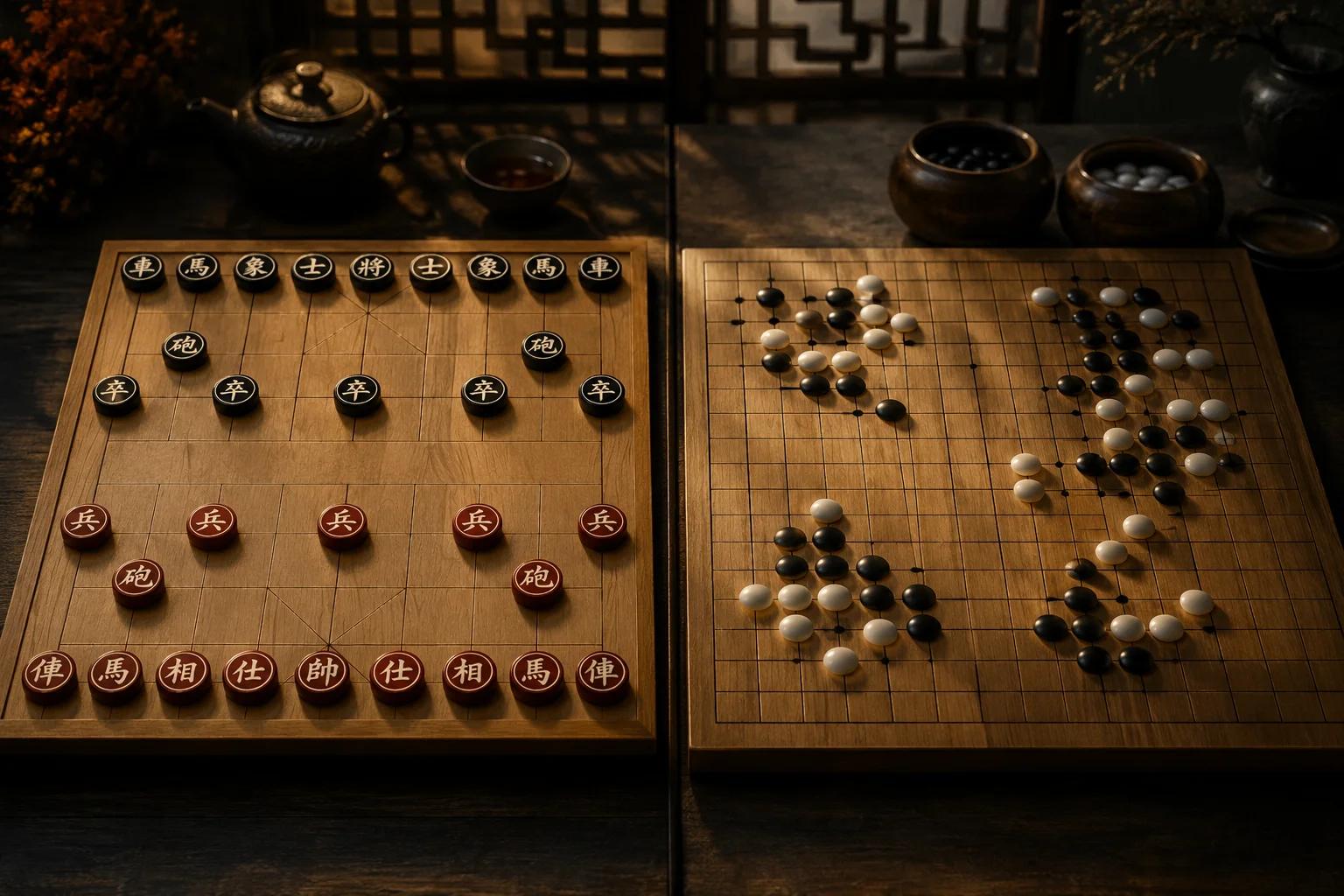
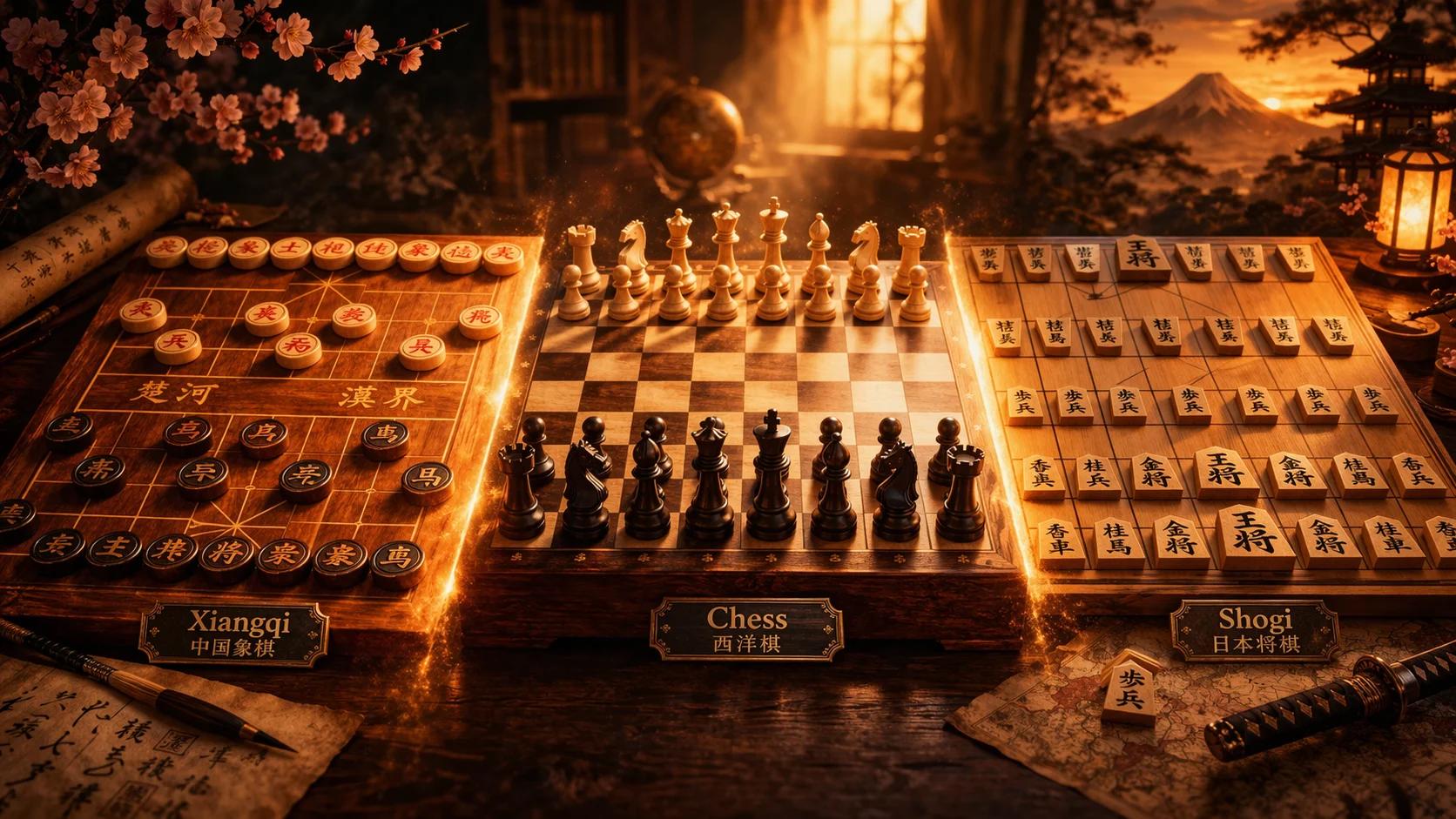
The Xiangqi board has 90 playable intersections versus the 64 squares of chess, creating a 40% larger playing space. This means more positional options and a broader game tree. However, complexity is not measured by board size alone. Xiangqi has restrictions that reduce complexity in certain areas: the General and Advisors are confined to the Palace, and Elephants cannot cross the River. Chess, on the other hand, has pieces with unlimited range (Queen, Bishop, Rook) that create more long-distance tactical possibilities. Read our detailed comparison for more differences.
Tactical Depth
Xiangqi introduces tactical mechanics that do not exist in chess. The Cannon, with its screen capture, creates completely unique tactical patterns. The Horse blocking rule adds another layer of calculation. The Flying General rule generates endgame tactics with no equivalent. However, chess has its own tactical complexity with castling, en passant, pawn promotion to any piece, and Queen pins. Both games offer virtually inexhaustible tactical depth for human players.
Endgames: Where Xiangqi Is More Demanding
This is probably the area where Xiangqi is clearly harder. In chess, stalemate is a draw, which allows many defensive resources. In Xiangqi, stalemate is a loss, making endgames much more aggressive and complex. Every move must maintain at least one legal move available. Xiangqi endgames require precise calculation because a mistake can turn a drawn position into a loss. Additionally, the absence of Soldier promotion means there is no safety net of creating a powerful piece in the endgame.
Learning Curve
For a complete beginner, chess may be slightly easier to start because the pieces move more intuitively and the Chinese characters on Xiangqi pieces can be intimidating. However, once past the initial barrier, the learning curve is similar. Both games require years of study to reach an advanced level. If you already play chess, learning Xiangqi is significantly easier because the fundamental concepts transfer. Check our guide for chess players for a smooth transition.
What Does Science Say?
Researchers have calculated that Xiangqi has a larger game tree than chess: approximately 10 to the power of 150 versus 10 to the power of 120 for chess. However, the state-space complexity (number of possible legal positions) is comparable. Artificial intelligence engines have reached superhuman levels in both games, but finding the best moves remains a different challenge in each. AI research has shown that both games are computationally intractable for brute force, requiring sophisticated positional evaluation.
The Verdict
Neither Xiangqi nor chess is objectively "harder." They are difficult in different ways. Xiangqi has more complex endgames, more diverse piece mechanics (the Cannon), and a larger board. Chess has pieces with greater mobility (the Queen), more promotion possibilities, and a more developed theoretical tradition in the West. The better question is not "which is harder?" but "which do I want to explore?" The ideal answer is: both. Start playing Xiangqi for free and discover a world of strategy that perfectly complements your chess knowledge.