Three Games, One Ancient Ancestor
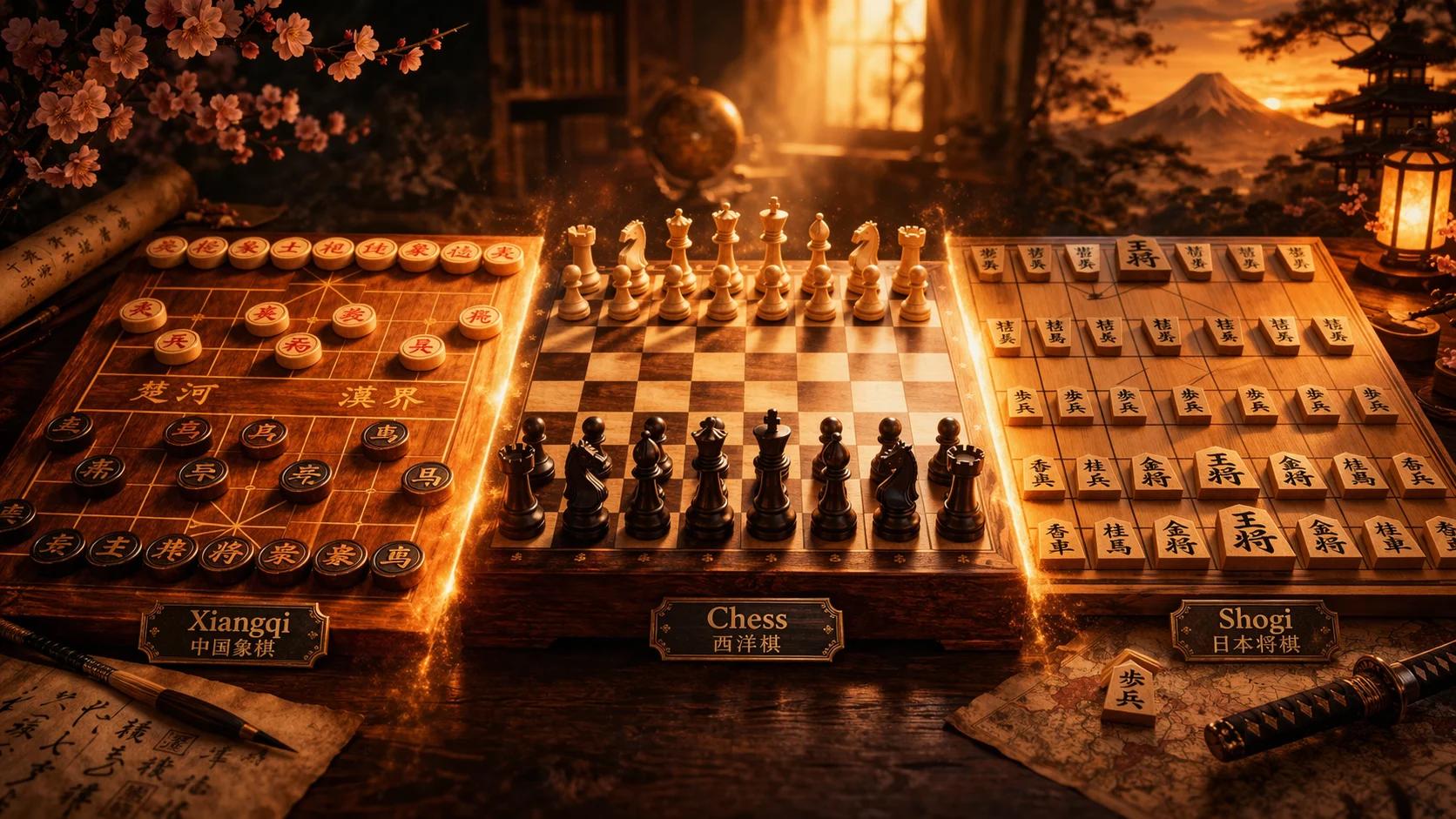
Xiangqi, Shogi, and Western Chess all descend from Chaturanga, an ancient Indian strategy game dating back to the 6th century. As Chaturanga spread along trade routes, it evolved into distinct games adapted to local cultures. Moving west through Persia and the Arab world, it became Shatranj and eventually modern Chess. Moving east into China, it became Xiangqi, incorporating Chinese military concepts like the river, palace, and cannon. From China, the game traveled to Japan where it transformed into Shogi, developing its most radical innovation: captured pieces can be returned to the board. Despite their common origin, these three games have diverged so significantly that mastering one provides only a modest advantage in the others. Each game has developed its own deep theory, professional scene, and cultural significance spanning centuries.
The Boards: Squares vs Intersections
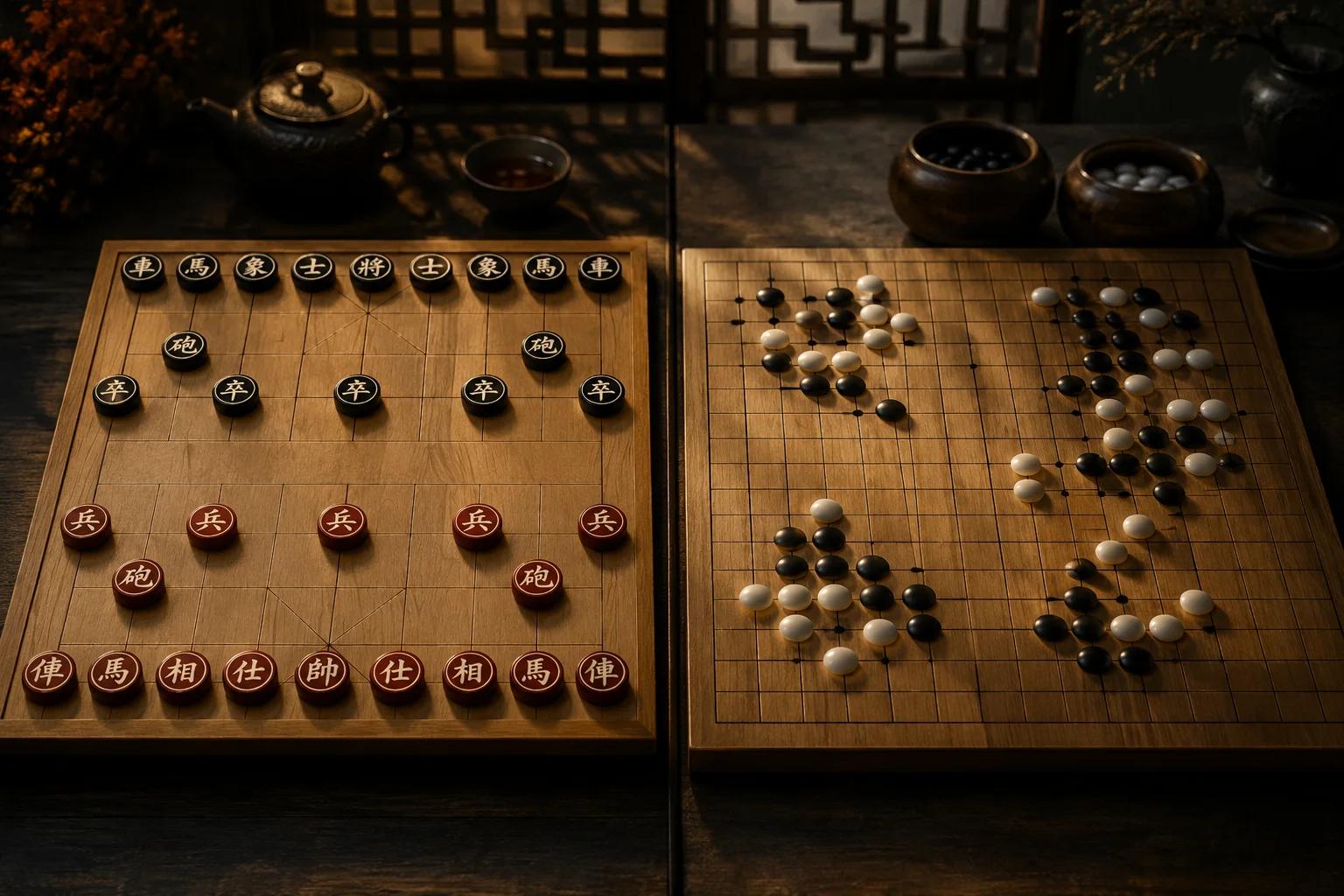
The most immediately visible difference is the board itself. Western Chess uses an 8x8 grid of alternating light and dark squares, with pieces placed inside the squares. Xiangqi uses a larger 9x10 grid where pieces are placed on the intersections of lines rather than inside squares, creating 90 playable points. The Xiangqi board is split by a river that affects piece movement. Shogi uses a 9x9 grid of uniform squares, similar to Chess but slightly larger. The Shogi board has no special zones. Xiangqi's intersection-based placement and river create a fundamentally different spatial feel: the board feels more open with longer lines of attack, and the river adds a strategic layer absent from the other two games.
Piece Movement: Familiar Yet Foreign
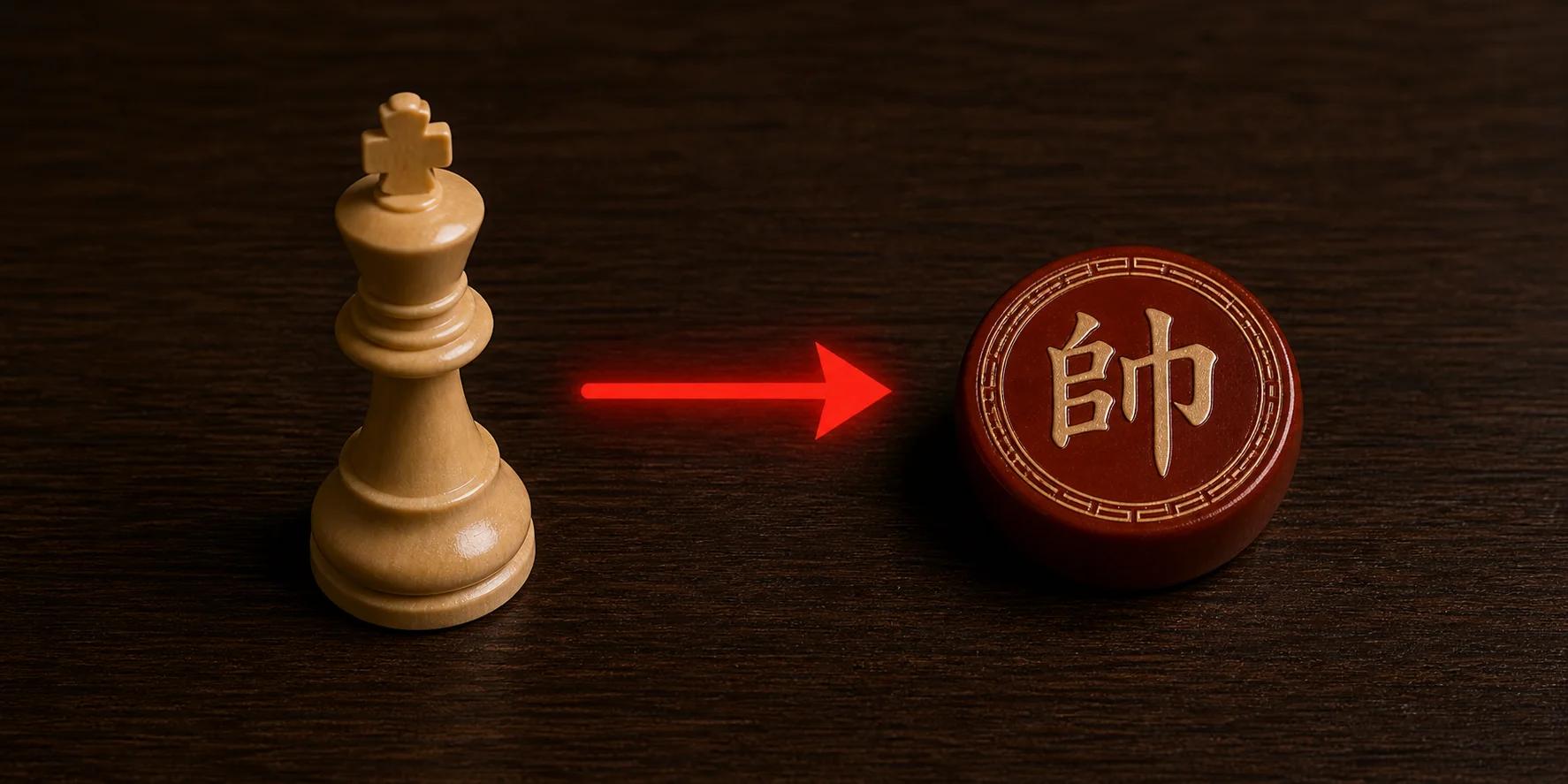
Many pieces share conceptual similarities across the three games but move differently. The Rook in Chess, the Chariot in Xiangqi, and the Rook in Shogi all move in straight lines along ranks and files. The Knight in Chess can jump freely, while the Xiangqi Horse can be blocked. Shogi has no jumping piece at all. Xiangqi's Cannon has no equivalent in either Chess or Shogi: it moves like a Rook but captures by jumping over exactly one piece. Shogi's unique feature is piece promotion: most pieces can be promoted (flipped over) when they reach the opponent's territory, gaining new movement abilities. The Bishop in Chess moves diagonally without limit, while Xiangqi's Elephant moves only two points diagonally and cannot cross the river. These differences mean that tactical patterns and strategic principles, while occasionally overlapping, are largely game-specific.
Shogi's Revolutionary Drop Rule
The most dramatic difference between the three games is Shogi's drop rule: captured pieces change sides and can be placed back on the board as your own pieces on any subsequent turn. This single rule transforms the entire nature of the game. In Chess and Xiangqi, trades simplify the position and reduce attacking potential. In Shogi, trades can actually increase danger because those captured pieces become ammunition for future attacks. A piece in hand is often more flexible than a piece on the board because it can be dropped exactly where it is needed. This means Shogi games rarely end in draws (less than two percent of professional games), positions stay sharp and dangerous throughout, and the concept of material advantage works completely differently. A player who is behind in material but has pieces in hand can launch devastating drop attacks.
Which Game Has the Deepest Strategy?
Each game has a distinct strategic personality. Western Chess is characterized by long-term positional planning, pawn structure theory, and the transition from opening to middlegame to endgame. The King is vulnerable but mobile. Xiangqi is faster and more tactical, with the river creating asymmetric attack and defense dynamics. The confined General and the Cannon's unique capture mechanism lead to sharp, aggressive play. Draws are less common than in Chess because stalemate is a loss. Shogi is the most complex in terms of possible positions because pieces never leave the game permanently. Strategy revolves around building attack formations (known as castles), piece coordination, and timing drops for maximum impact. All three games reward deep calculation, pattern recognition, and strategic planning, but the specific skills transfer only partially between them.
Cultural Significance and Community
Each game holds deep cultural importance in its home region. Chess is truly global, with FIDE organizing world championships since 1886 and an estimated 600 million players worldwide. Xiangqi is the most played board game in the world by number of regular players, with an estimated 500 million players predominantly in China, Vietnam, and Southeast Asian communities worldwide. Shogi has approximately 30 million players, almost entirely in Japan, where professional players are celebrities and major tournaments are nationally televised. All three games have active online communities. Chess has Lichess and Chess.com, Xiangqi has platforms like Xiangqi One bringing the game to international audiences, and Shogi has 81Dojo and ShogiWars. The cultural context shapes how each game is taught, played, and appreciated.
Which Game Should You Play?
If you enjoy long-term strategic planning and have access to the largest global community, Chess is the natural choice. If you want fast, tactical play with unique pieces like the Cannon and a game that rewards aggressive play, Xiangqi is for you. If you love the idea that no piece ever truly dies and want the most complex variant with the sharpest positions, try Shogi. The best answer, of course, is to try all three. Skills in one game often provide interesting perspectives on the others: a Chess player will appreciate Xiangqi's Chariot, a Xiangqi player will find Chess endgames familiar, and a Shogi player will bring a unique sense of dynamic piece activity to any strategy game. Xiangqi One makes it easy to learn Xiangqi from scratch with interactive tutorials, regardless of your background in other strategy games. Discover how each piece moves or jump straight into a game with our AI bots.