Why Was Xiangqi Added to the Asian Games?
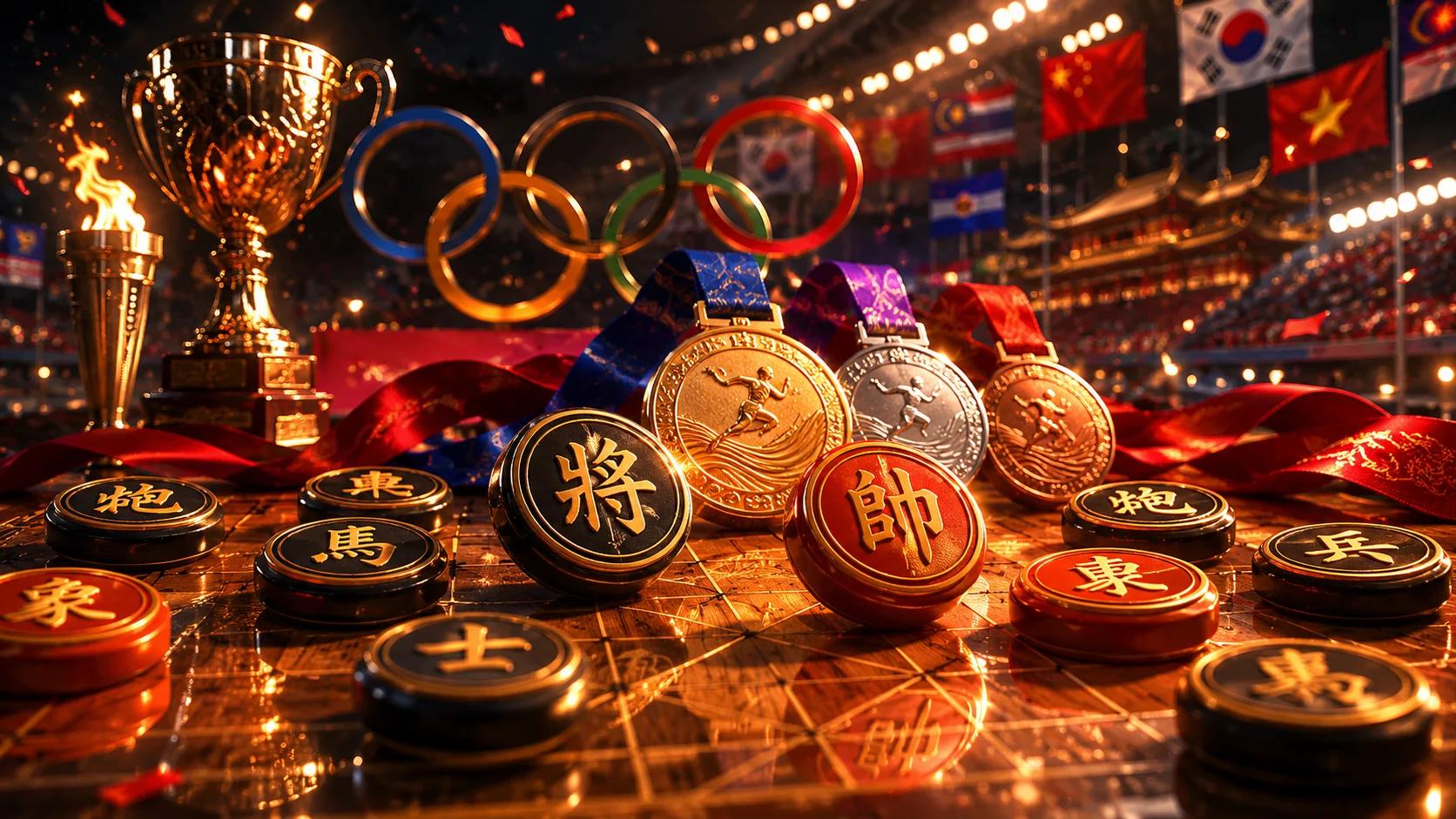
The inclusion of Xiangqi in the 2010 Asian Games in Guangzhou marked a turning point in the history of the game. For the first time, Chinese Chess was officially recognized as a competitive sport, alongside athletics and swimming. This recognition did not come by chance: since the 1990s, China and several Asian federations had been lobbying to bring mind sports into the regional Olympic movement. The Olympic Council of Asia eventually agreed to create a dedicated category grouping Xiangqi, Go (Weiqi), international chess, and contract bridge. This decision reflected a desire to spotlight disciplines deeply rooted in Asian culture. The history of Xiangqi thus took on a new international dimension, moving from cultural tradition to certified sport.
Guangzhou 2010: The Historic First Edition
The Guangzhou Asian Games in November 2010 saw Xiangqi contested for the first time as an official event. Two gold medals were on the line: men's individual and women's individual. The competition brought together the continent's best players, primarily from China, Vietnam, Hong Kong, Macau, Singapore, and Malaysia. China took both gold medals, confirming its historical hegemony in the game. Vietnam delivered solid performances: Nguyễn Thành Bảo notably won the men's silver medal, underlining the rising strength of the Vietnamese school. Full medal tables and results from all editions are archived on the Xiangqi at the Asian Games Wikipedia page. The event took place at the Guangzhou Chess Institute, a venue specially equipped for mind sports. National television coverage in China reached tens of millions of viewers, propelling professional Xiangqi players into the spotlight like never before.
Hangzhou 2023: The Long-Awaited Return
After Guangzhou 2010, Xiangqi went through an uncertain period. The 2014 Incheon and 2018 Jakarta-Palembang Asian Games did not include the discipline, as South Korea and Indonesia prioritized other sports. It took until the Hangzhou Asian Games for Xiangqi to return to the official program. Originally scheduled for 2022, these Games were postponed to September 2023 due to the COVID-19 pandemic. Hosting in China was particularly symbolic: Hangzhou is a city historically tied to literary culture and the game of Chinese Chess. The format kept the three main events. Organizers introduced modern broadcasting with live streaming and mobile apps, marking increased professionalization. For broader context on Xiangqi's competitive evolution, see our coverage of the Xiangqi World Championship history.
Competition Format and Specific Rules
The format adopted at the Asian Games draws directly from the World Championships organized by the World Xiangqi Federation. Individual events use a Swiss system over seven to nine rounds, with a rapid time control suited to broadcast: typically 60 minutes per player plus a 30-second increment per move. The team event pits national squads of four players against each other, with one mandatory female player, competing across multiple boards in simultaneous matches. Tiebreakers use the classical criteria: Buchholz, progressive score, head-to-head. Anti-cheating regulations are strict, with supervision by arbiters trained by the World Xiangqi Federation (WXF). This professional structure places Xiangqi on par with other major disciplines in the Asian Games program.
Chinese Dominance and Credible Challengers
The Asian Games medal record reflects the global Xiangqi hierarchy: China dominates uncontested. In both 2010 and 2023, gold medals consistently went to Chinese players, demonstrating an incomparable depth of talent pool. Asian champion Wang Tianyi stands among the leading figures of this era, confirming his status as the dominant player of his generation. Vietnam is the main credible challenger: its Vietnamese grandmasters regularly climb the podium and occasionally inflict surprise defeats on the Chinese contingent. Hong Kong, Macau, and Singapore also field competitive squads. This Chinese dominance echoes the Soviet era in international chess — and raises the question of how to diversify the sport at the highest level over the coming decades.
How Do You Qualify for the Asian Games?
Qualifying for Asian Games Xiangqi runs through the national federations recognized by the Olympic Council of Asia. Each member country picks its representatives based on its own criteria, generally rooted in national rankings and international tournament results. China, Vietnam, and Hong Kong, which operate structured professional circuits, select players via dedicated qualifying tournaments. For other countries, the process is more flexible: the best available players are nominated directly. The number of spots per nation is capped to preserve tournament competitiveness. International amateur players can dream of participation by building their rating through WXF-affiliated tournaments. A solid grasp of Xiangqi fundamentals remains essential, and understanding Xiangqi Elo ratings helps players position themselves on the international scene.
Is Xiangqi an Olympic Sport?
Let's be precise: Xiangqi is not an Olympic sport in the strict sense of the Summer or Winter Olympic Games. It is a discipline recognized by the Olympic Council of Asia, granting it a quasi-Olympic regional status but without a presence at the global Olympics. This distinction stems from the International Olympic Committee's criteria, which favor sports with worldwide practice, television appeal, and physical performance. Mind sports, despite their millions of practitioners, struggle to clear this threshold. Even international chess, with its universal status, remains outside the main Olympic program. For Xiangqi, the realistic goal is to consolidate its place in the Asian Games and extend recognition through the World Mind Sports Games. The comparison with international chess sheds useful light on these shared institutional challenges.
Aichi-Nagoya 2026: Dropped from the Program
The 2026 Asian Games will take place in Aichi-Nagoya, Japan, from September 19 to October 4. Xiangqi, along with all other board games, has been dropped from the official program for this edition. Japan prioritized sports with a stronger domestic tradition, and the organizing committee exercised its discretion to trim the optional-sports list. The decision is a real institutional setback: losing a second consecutive edition after the Incheon and Jakarta gaps risks eroding the legitimacy that Guangzhou 2010 and Hangzhou 2023 had built. The WXF and the Chinese and Vietnamese federations are already working toward securing a return for the 2030 Asian Games, expected in Doha. In the meantime, fans can follow international competition through the World Xiangqi Championship cycle and practice on platforms like Xiangqi One.
What Future for Olympic Xiangqi?
The future of Xiangqi at the Asian Games will depend on several factors. First, media appeal: the world federation is working to make the discipline more telegenic with rapid time controls, expert panels, and real-time analysis. Second, geographic expansion: as long as Xiangqi remains confined to a few Asian nations, its status will stay fragile. Third, professionalization: the international circuit must keep being structured, as Vietnam has done in recent years. Long-term, leaders aim to integrate Xiangqi into the World Mind Sports Games program and pursue broader global recognition. The steady growth of online players, reachable through modern platforms, demonstrates that the player base is solid. To explore more of the game's competitive universe, browse our history articles and our gallery of famous players.