Why does Xiangqi mirror Chinese warfare?
Before being entertainment, Xiangqi is a war map. The board, cut in two by the Chu-Han river (楚河漢界), reproduces the historical frontier that, in the 3rd century BCE, separated the kingdoms of Chu and Han during the civil war that followed the fall of the Qin dynasty. Each piece names a branch of the imperial Chinese army: the general stays confined in his palace (宮), advisors never leave the nine palace points, war elephants patrol friendly territory and refuse to cross the river, chariots roll in straight lines, and horses sidestep around obstacles. This geography is not decorative — it reproduces the military hierarchy and the logistical constraints of a pitched battle. For a piece-by-piece walkthrough, see our guide to Xiangqi pieces. Where other chess variants of Indian origin stylized their armies, Xiangqi remains, in its very letter, faithful to the Chinese art of war.
What is its place in Chinese philosophy?
Xiangqi quietly converses with three great traditions of thought. With the Yi Jing (Book of Changes), it shares the idea that every position is a provisional state, crossed by opposing tendencies whose balance flips with each move: Yin and Yang are not two camps, but two poles of the same game. With The Art of War attributed to Sun Tzu, it shares the conviction that victory is prepared before contact — through occupation of lines, intelligence, and the constraints imposed on the opponent; winning without fighting remains the higher ideal. With Confucian thought, finally, it shares praise for patience, self-control, and respect for protocol: you do not take back a move, you greet your opponent, you accept defeat without losing face. The board becomes an exercise in temperance as much as an intellectual joust.
Xiangqi in classical Chinese literature
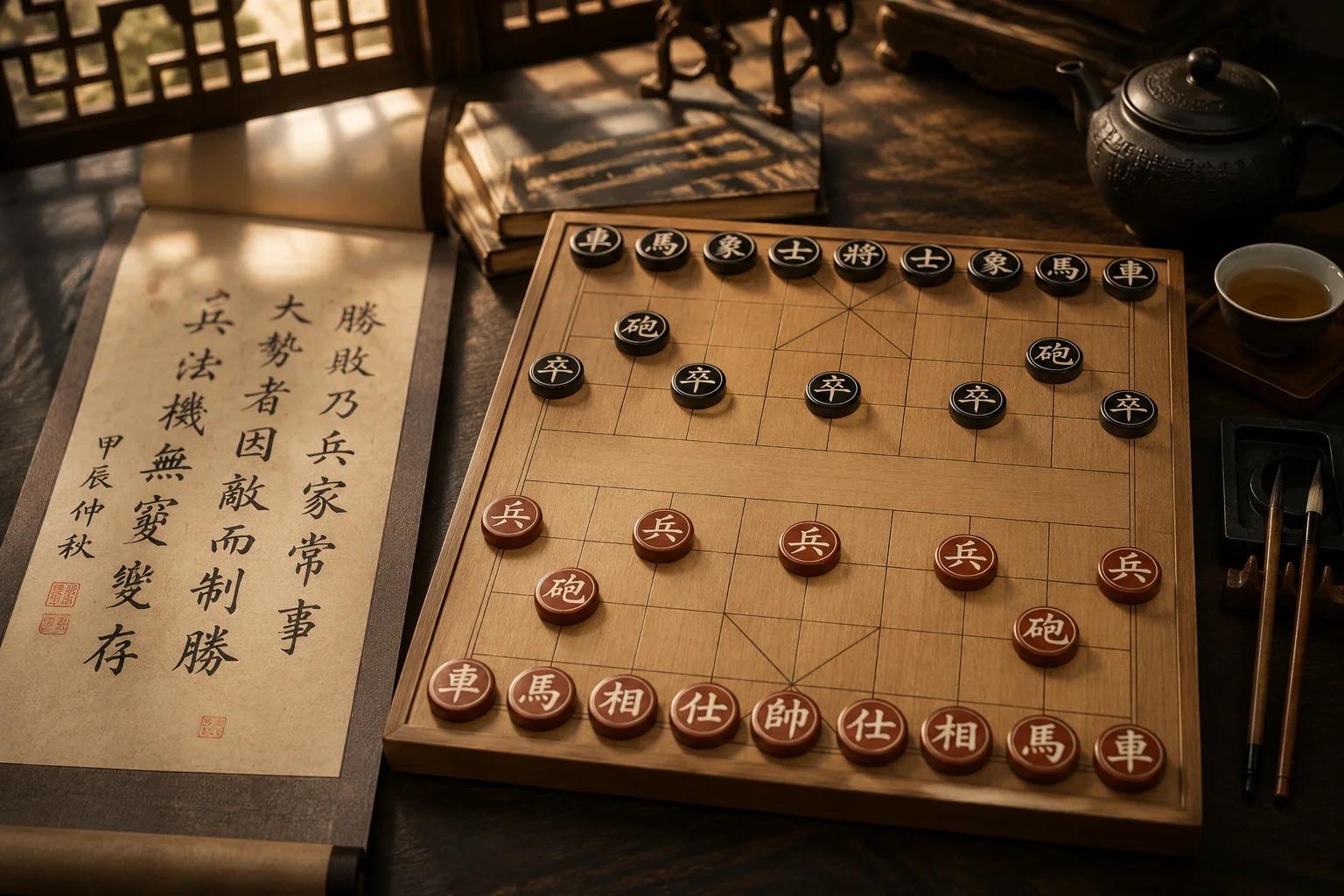
From the Tang dynasty (618-907) onward, scholar-poets made Chinese chess a recurring theme: one meets the solitary sage at his board, the hermit who forgets the world mid-game, the minister who weighs affairs of state between two moves. Tang poetry willingly pairs Xiangqi with the contemplation of nature, tea, and calligraphy — the four arts of the cultivated mind (琴棋書畫) actually include qi, the generic term for chess and board games. Under the Ming (1368-1644) and Qing (1644-1911) dynasties, the game entered the great novel and popular theater: it served as a metaphor for court intrigues, family rivalries, and political reversals. This literary presence durably installed Xiangqi as a shared cultural code: to evoke a game is to evoke patience, cunning, and the measure of slow time.
A painting scene, a street scene
Classical Chinese painting fixed a recurring image: two scholars beneath a pine tree, a board laid on a rock, a third figure watching in silence. This iconography, inherited from the Song and Yuan dynasties, made Xiangqi an emblem of erudite retreat, chosen friendship, and suspended time — the exact opposite of the bustle of public affairs. The same scene replays today, in a more popular form: in the urban parks of Beijing, Shanghai, Guangzhou, Hanoi, and Taipei, players of every age gather around stone tables, often doubled by onlookers who comment aloud. The social ritual has endured: a cup of tea, a folding fan, a game commented by a circle of regulars. For the strictly comparative angle with other traditions, see our Xiangqi vs Western chess article.
A school of patience across generations
In mainland China, Taiwan, Hong Kong, Singapore, and Vietnam, Xiangqi plays a social role far broader than that of a hobby. It serves as an intergenerational bridge: the grandfather teaches the grandchild, the retiree faces the student, the stranger in the park becomes an opponent for an evening. This informal transmission carries an implicit ethic — think before you act, accept the opponent's move, measure your strength. Where Western sport often celebrates aggression and individual expression, Xiangqi culture foregrounds the calm of the face, the steadiness of breath, and command of silence. Children there do not only learn to calculate a combination — they learn an etiquette. It is, to borrow a common phrase, an open-air school of patience.
Chinese vs Western strategy: two mindsets
The comparison between Xiangqi and Western chess runs deeper than rules — it opposes two ways of relating to strategy. The Confucian spirit, dominant on the Chinese side, prizes position, waiting, and continuous pressure on the opponent: winning without ever needing to strike the decisive blow. The Western competitive spirit often privileges initiative, sharp attack, and quick resolution. The contrast even shows up in pacing: a Xiangqi player gladly accepts a long war of attrition, where the Western chess tradition praises the spectacular sacrifice. To go further on the mechanical contrasts, see Xiangqi vs Shogi vs chess and our upcoming Xiangqi vs Go comparison. No mindset is superior — but each reflects a history, a language, and a vision of conflict.
Is Xiangqi a cultural heritage?
The answer is now official: Xiangqi is listed as intangible cultural heritage of the People's Republic of China, on the same shelf as calligraphy, Peking opera, and traditional medicine. This nationwide recognition protects the practice, funds schools, supports federations, and frames the training of coaches. It expresses a conviction: a game can be a common good. Vietnam, Taiwan, Hong Kong, and Singapore maintain their own associations and competitions, and certain games played by the great historical players of the 20th century are studied the way one comments a classical poem. This heritage dimension explains why the Chinese state, but also diaspora communities, invest in the transmission of the game — it is not merely a pastime, it is a fragment of identity.
Massive popularity, still alive
Estimated at nearly 300 million practitioners across the Sinophone world and beyond, Xiangqi remains one of the most played games on the planet. Mainland China sustains a professional league with salaries comparable to those of other intellectual disciplines, while live broadcasts gather millions of viewers on local platforms. In Taiwan, the game remains a school landmark; in Hong Kong and Singapore, it accompanies neighborhood life; in Vietnam, its popularity rivals that of China itself. Digitization has extended this vitality: today, Xiangqi One lets any player, beginner or veteran, find an opponent in seconds, anywhere in the world. To place this tradition in the long arc of history, read our history of Xiangqi or explore more culture and history articles.