What is the Elo rating and where does it come from?
The Elo system was invented in the 1960s by Arpad Elo, a Hungarian-American physicist and devoted chess player (the full mathematical mechanics are explained on the Elo rating system Wikipedia page). The US Chess Federation adopted it in 1960, FIDE followed in 1970, and it has since become the de facto standard for measuring strength in two-player strategy games. Xiangqi transposed this system quite naturally: Elo's mathematical structure does not depend on the specific rules of the game, only on results between players. Today, the World Xiangqi Federation (WXF), the Chinese Xiangqi Association (CXA), and most online platforms use a variant of the Elo system to rank their players. For broader context on international Xiangqi, read our overview of the WXF. The beauty of the Elo system is that it turns a series of binary outcomes (win, draw, loss) into a single number that predicts the probability of future encounters.
How does the Elo calculation work?
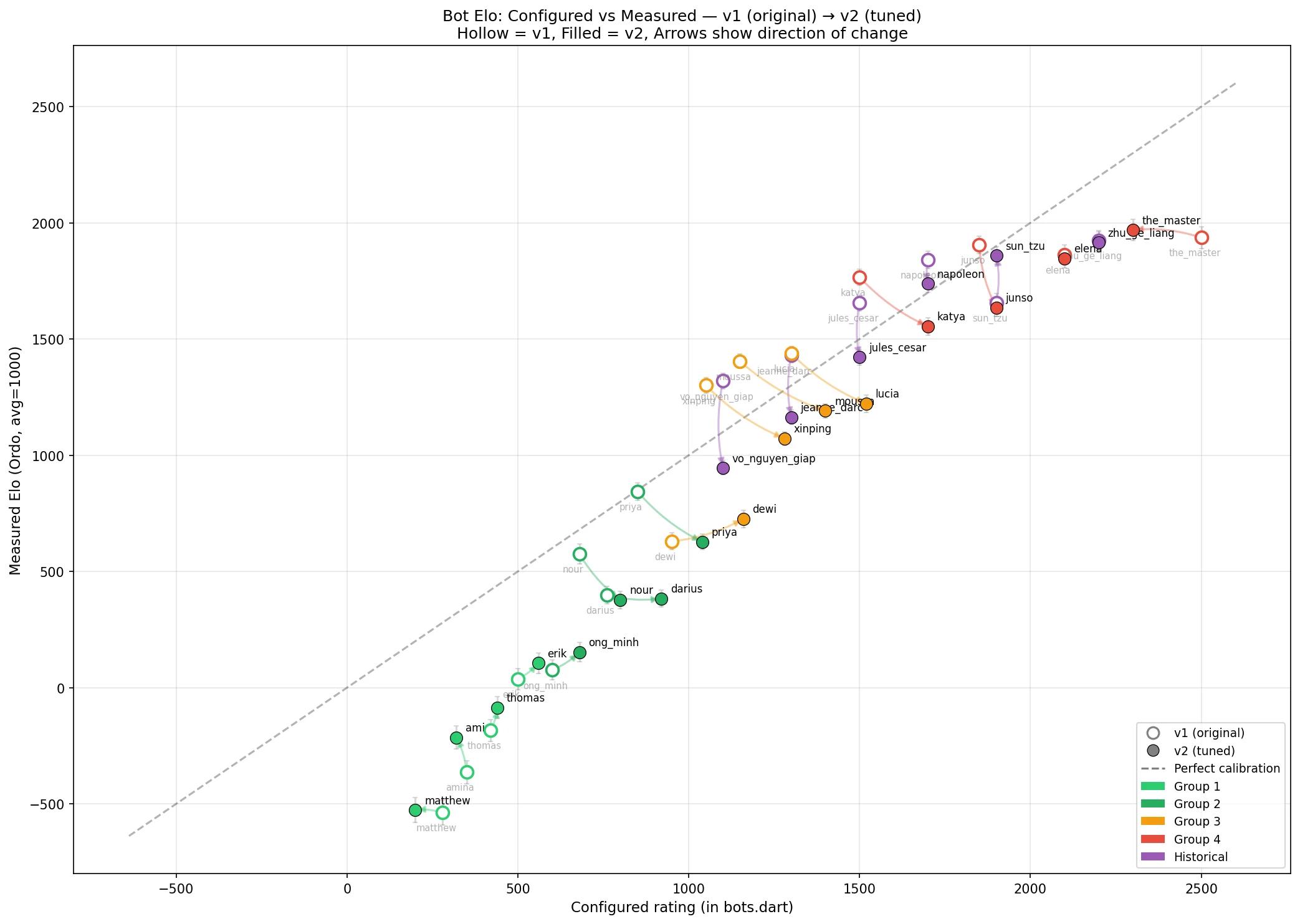
The core principle is simple: the rating difference between two players predicts the probability of winning. If you are rated 1600 and your opponent is 1400, your rating is 200 points higher, which corresponds to roughly 76% chances of winning under the Elo formula. A 400-point gap means about 91% wins for the stronger player. After each game, your rating moves based on the gap between the actual result and the expected result. Beating a weaker player earns you little; beating a stronger one earns you a lot. Losing to a weaker player costs heavily; losing to a stronger one costs little. The K-factor controls the rate of change: beginners typically use a high K (32 or 40) so their rating converges quickly to their true level, while titled players use a lower K (10 or 16) to stabilize their ranking. The exact same mathematics powers the way we balance bot difficulty on Xiangqi One.
What are typical Xiangqi rating scales?
Xiangqi rating scales broadly mirror those of international chess, even if exact numbers vary across federations. An absolute beginner typically sits between 600 and 1000 points. They know the rules but still lack tactical consistency. A solid club player ranges between 1200 and 1800: they master basic tactical patterns, classical openings like the central cannon, and common endgames. Beyond that, you enter serious competitive territory. A regional expert reaches 1800 to 2200, able to beat most amateurs and challenge some titled players. The 2200 threshold traditionally marks entry into the elite. For an overview of progression paths, read our Xiangqi improvement guide. These ranges are indicators: a serious 1500 player can beat a 1700 in poor form, and individual variance is real.
What rating does a Xiangqi Grandmaster have?
At the top of the pyramid, official titles follow a precise hierarchy. The National Grandmaster title (国家大师, Guójiā Dàshī) in China roughly corresponds to a rating of 2200 to 2400 and already represents a solid professional level. The International Grandmaster, awarded by the WXF, requires a rating around 2400 to 2500 and sustained performance in qualifying international tournaments. Above that, the most prestigious Chinese title is the Special Grandmaster (特级大师, Tèjí Dàshī), reserved for a handful of players who have achieved exceptional results at the highest level. Super-Grandmasters, comparable to super-GMs in chess, exceed 2600 points and represent the absolute world elite at a given moment. To explore iconic trajectories, read our portraits of Wang Tianyi and Hu Ronghua, two figures who embody this Chinese elite.
How does Xiangqi compare to international chess?
On the surface, the numbers look similar: a 2500-rated Xiangqi GM and a 2500-rated chess GM occupy analogous positions in their respective pyramids. But this numerical equivalence hides very different realities. The player pool is radically asymmetric: FIDE counts more than 200,000 rated players, while Xiangqi federations manage tens of thousands of titled players, heavily concentrated in China, Hong Kong, Vietnam, and the Asian diaspora. This scale difference affects the statistical stability of ratings: with fewer rated games per player, variance is higher in Xiangqi. The computational complexity of the two games is itself a topic, covered in our article is Xiangqi harder than chess?. Finally, the competitive calendar differs: major Xiangqi tournaments are fewer, which slows rating evolution compared to the FIDE circuit.
The CXA and WXF rating systems
The Chinese Xiangqi Association (CXA) manages the densest and most competitive system in the world. It awards the official Chinese titles (国家大师 and 特级大师) based on criteria combining rating, national championship performance, and results in the professional league. The Chinese Xiangqi league is the functional equivalent of major national chess championships: it is where players accumulate their rating and prove their level. The World Xiangqi Federation (WXF), founded in 1993, structures international competitions and awards the International Grandmaster title. Its ranking integrates results in world tournaments, the Asian Games (see our article on Xiangqi at the Asian Games), and continental championships. The two systems coexist: a player may hold a Chinese National Grandmaster title without being a WXF International Grandmaster, and vice versa, depending on which competitions they have played.
Why does my online rating differ from the official one?
This is a recurring question, and the answer comes down to three factors. First, the player pools differ. An online rating reflects your relative strength within that platform's user base, not the global population. If the platform attracts mostly strong players, your rating there will mechanically be lower than elsewhere. Second, time controls differ. Online ratings are often computed on rapid or blitz games, which measure something different from the official WXF rating (usually classical). A strong classical player may be average at blitz, and vice versa. Third, the algorithms vary. Some platforms use Glicko or Glicko-2, which adjust confidence around each rating; others stick with classical Elo. This is exactly why we chose to remove numerical ratings from our app's main interface and structure difficulty into explicit tiers. To play against bots calibrated to the level you want, open Xiangqi One.
How do you improve and raise your rating?
Raising your rating in a lasting way rests on three pillars: a theoretical base, tactical training, and rigorous analysis of your own games. On theory, mastering a few main openings prevents you from losing the game before move 15; our introduction to strategy for beginners covers the fundamental patterns. Tactics is the fastest engine of progress below 2200: most games at that level are decided on a missed tactical shot. Twenty minutes of puzzles per day yields spectacular results within months. Finally, analyzing your own games, ideally with a strong engine, turns every loss into a lesson. Our article on Xiangqi AI engines explains how to use these tools without becoming dependent on them. Avoid the classic mistake of playing 200 blitz games per week without analyzing anything: rating only reflects what you learn, not the hours you invest.
Beyond the rating: the real measure of your game
It is tempting to reduce your level to a single number, but the Elo rating is only a statistical summary of past results. It says nothing about your strategic understanding, your psychological resilience, or your enjoyment of the game. Many strong 2200 players have specific weaknesses (endgames, closed positions, time management) that a single ranking cannot reveal. Conversely, a 1600 player may have remarkable positional understanding but lose tactically. The Elo system is a useful measurement tool, not a value judgment about your relationship with the game. To discover the history of top-level competition, read our history of the Xiangqi world championship. To practice in an environment where progress matters more than the displayed number, open Xiangqi One and pick the difficulty tier that fits you. For more technical articles on engines, analysis, and ratings, browse the engines category.