The Horse's Movement
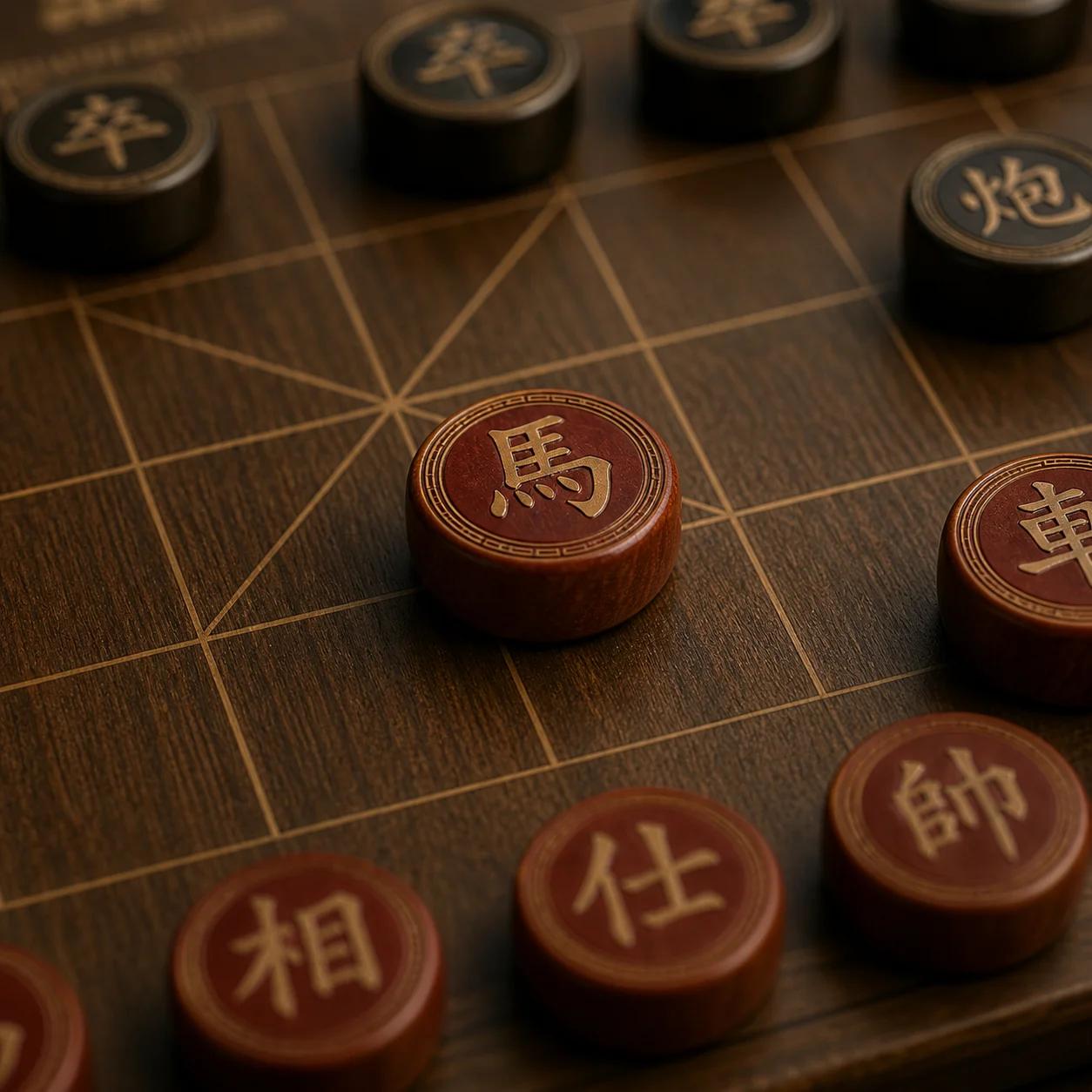
The Horse (馬/马, Ma) moves in an L-shape: one point in a straight line (horizontally or vertically) and then one point diagonally outward. This gives it up to eight possible destinations from a central position. Unlike the Western chess Knight, the Xiangqi Horse can be blocked. If a piece occupies the point adjacent to the Horse in the direction of its first step, the Horse cannot move in that direction. This blocking rule, called "hobbling the Horse's leg," adds a tactical layer absent from Western chess.
The Blocking Rule Explained
The blocking rule is what fundamentally distinguishes the Xiangqi Horse from the chess Knight. If the Horse wants to move to the right (one horizontal step), the intersection directly to its right must be clear. If that intersection is occupied by any piece (friendly or enemy), the Horse cannot go in that direction. This means in closed positions with many pieces, the Horse can become completely immobilized. Learning to block your opponent's Horses while keeping yours free is a fundamental strategic skill.
The Horse in the Opening
In the opening, Horses are typically developed toward the center of the board. The most common squares are those that protect the center and prepare future attacks. In the Screen Horse Defense, both Horses are positioned to defend against the opponent's Central Cannon. Developing Horses early is important, but be careful not to place them where they can be easily blocked. A well-developed Horse controls multiple intersections and supports both attack and defense.
Attack Tactics with the Horse
The Horse shines in open positions where it can reach many intersections. The Horse fork is a classic tactic where the Horse attacks two pieces simultaneously, forcing the opponent to lose material. The Horse is also excellent for checking the enemy General from unexpected angles, as its L-shaped movement allows it to bypass linear defenses. The Horse and Chariot combination is especially dangerous: the Chariot controls straight lines while the Horse attacks from diagonals, creating threats that are hard to defend.
The Horse in the Endgame
Unlike the Cannon, the Horse maintains or even increases its value in the endgame. With fewer pieces on the board, there are fewer obstacles that can block it, allowing it to move freely. A well-positioned Horse near the enemy Palace can be devastating, especially when combined with a crossed Soldier. The Horse can create checkmate threats that are very difficult to defend with just the General and Advisors. For this reason, many players prefer to keep their Horses for the endgame.
Common Mistakes with the Horse
The most common mistake is developing the Horse too early without considering that it can be easily blocked. Another frequent error is forgetting the blocking rule when calculating variations: many beginners plan sequences that depend on the Horse without noticing that a piece blocks its path. It is also a mistake to trade a Horse for a Cannon in the late middlegame, as the Horse is usually more valuable in the endgame. Practice your calculation by solving puzzles on Xiangqi One to avoid these mistakes.
Horse vs Cannon: When to Trade?
The Horse and Cannon have similar values (around 4.5 points), but their strengths vary depending on the game phase. In the opening and early middlegame, when the board is full of pieces, the Cannon is usually stronger because it has many available screens. As pieces are traded, the Horse becomes stronger because it has fewer obstacles. As a general rule, if you expect the game to simplify, keep the Horse. If the position will remain complex, the Cannon may be preferable. Check our pieces guide for more details on relative values.