What Is the Palcorner Cannon?
The Palcorner Cannon, known in Chinese as Shi Jiao Pao (仕角炮, literally "Cannon at the Advisor's corner"), is a strategic Xiangqi opening in which Red moves the Cannon not to the center but a single square, just in front of one of its own Advisors. Typical notation is C2.6 or C8.6 depending on which side is chosen (the Cannon shifts from the second or eighth file up to the sixth rank). The visual result is striking: the Cannon ends up sandwiched between the back-rank pieces and the rest of the board, ready to support a flank attack. This opening belongs to the broader family of Xiangqi opening systems and is one of the most respected alternatives to the Central Cannon.
Why Play a Less Popular Opening?
The Palcorner Cannon is played far less frequently than the Central Cannon, and that is precisely its strength. Most intermediate players have memorized deep lines against the Central Cannon, but few know the nuances of the Shi Jiao Pao. By choosing this opening, Red immediately steers the opponent away from familiar territory and forces independent thinking from the very first moves. Strategically, the opening favors asymmetric, flexible development over an immediate central clash. The Cannon poses no tactical threat on move one, but it prepares a harmonious deployment of Chariots and Horses. It is a patient, almost positional approach that can unsettle attacking players. To understand the Cannon's overall role in Xiangqi strategy, see our complete Cannon guide.
The Strategic Idea Behind Shi Jiao Pao
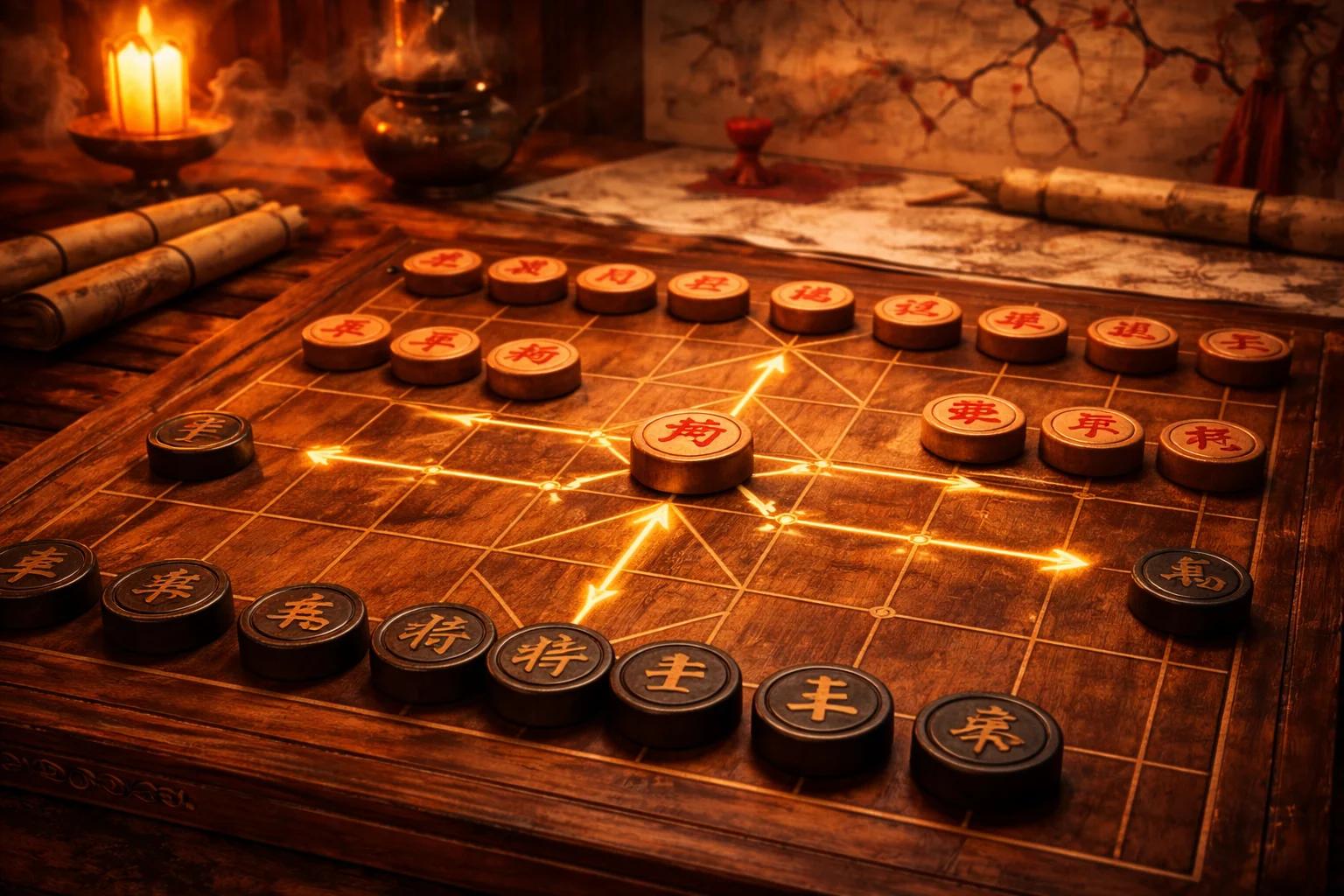
The brilliance of the Palcorner Cannon lies in its economy. In a single move, the Cannon clears its starting file so the rim Chariot can rise quickly, while staying active on its new diagonal of attack. The Cannon "sandwiched" between its General and the outside column applies latent pressure: it can swing toward the center, jump over a screening piece to attack, or simply support a Soldier advance on the wing. Unlike the Central Cannon, which announces its intentions loudly, the Shi Jiao Pao hides Red's plans. Red can then choose to attack on the flank, play a positional middlegame, or build a mixed assault. This flexibility makes the opening a valuable tool against opponents who dislike uncertainty.
The Typical First Move and Its Variants
The opening move of the Palcorner Cannon is usually notated C2.6 or C8.6: the Cannon leaves its starting square (file 2 or 8 depending on the side) and moves one rank up, settling just in front of the same-side Advisor. On Red's right side, the Cannon thus ends up directly adjacent to the Advisor, which is the origin of the opening's name. A notable variant consists of playing the Horse before the Cannon, or swapping the move order to obscure intentions further. Some classical treatises also describe a version where the Cannon eyes a diagonal toward the opposite side of the board — hence the occasional nickname "diagonal Cannon." Whichever order is chosen, the goal remains the same: prepare a measured attack rather than a frontal assault.
How Should Black Respond?
Facing the Palcorner Cannon, Black has several solid replies. The most classical is the Screen Horse defense, developing both Horses toward the center to maintain a balanced structure. This defense effectively neutralizes Red's asymmetric setup. Another popular response is Black's own Central Cannon: since Red has not claimed the center file, Black can install a Cannon there and seize the initiative. More aggressive players sometimes choose a quick counterattack on the wing opposite to Red's Cannon, exploiting the imbalance. Whatever the path, Black must avoid passive play: letting Red calmly install pieces effectively hands over several tempi for free.
Typical Plans for Red
After the Palcorner Cannon, Red usually follows a multi-phase plan. First, rapid development of the Chariot on the Cannon's side, often by lifting that Chariot up the freed file (the first or ninth file). Second, harmonious deployment of the Horses, ideally toward squares 3 and 7 to support flank operations. Third, a measured advance of the Soldier on the active side to open lines of attack. The hallmark of this opening is that the attack develops on the wing rather than through the center. The Cannon tucked near the Advisor can suddenly leap over a screening piece to strike at Black's defenses. Understanding the relative value of the pieces is essential for evaluating the exchanges that arise in these flank positions.
Comparison with the Central Cannon
The Central Cannon and the Palcorner Cannon represent two opposing philosophies of Xiangqi. The Central Cannon is direct, aggressive, and statistically more effective: it sets up an immediate threat and forces the opponent to react. The Palcorner Cannon, by contrast, is patient, asymmetric, and flexible: it prepares the attack without triggering it right away. Theoretically, the Central Cannon has generated thousands of pages of analysis and remains the reference opening at the professional level. The Shi Jiao Pao, though rarer, still has a solid body of theory and has been used occasionally by top players to surprise opponents in important matches. For the club player, alternating between these two openings builds a more complete understanding of Xiangqi structures and avoids becoming predictable.
When Should You Play This Opening?
The Palcorner Cannon shines in several specific situations. It is an ideal weapon when facing an opponent you know to be very well prepared against the Central Cannon: by switching systems, you neutralize their theoretical advantage. It is also an excellent choice in rapid or blitz games, where the surprise factor matters most. The opening particularly suits players who enjoy flexible, positional middlegames rather than violent tactical clashes. Conversely, if you absolutely need to win and you are stronger in direct attack, the Central Cannon remains statistically superior. To practice the Shi Jiao Pao in a real setting, play a few games on Xiangqi One against bots of different levels. Also explore our openings category to discover other complementary systems.
Building a Repertoire Around the Palcorner Cannon
To integrate the Palcorner Cannon into your repertoire durably, treat it as a system rather than a memorized sequence of moves. Study the typical development patterns of the Chariots and Horses that follow the Cannon's first move. Explore possible transpositions to other corner openings, such as the upcoming Three-Step Tiger, which shares some strategic ideas. Analyze your own games to identify the moments when you abandon the flank plan for a central one — often a mistake in this opening. Deepen your overall understanding of the middlegame through our upcoming guide on middlegame mastery. With a few weeks of practice, the Palcorner Cannon will become a reliable weapon that few opponents will know how to counter correctly.