Why Sacrifice a Piece Worth Only 2 Points?
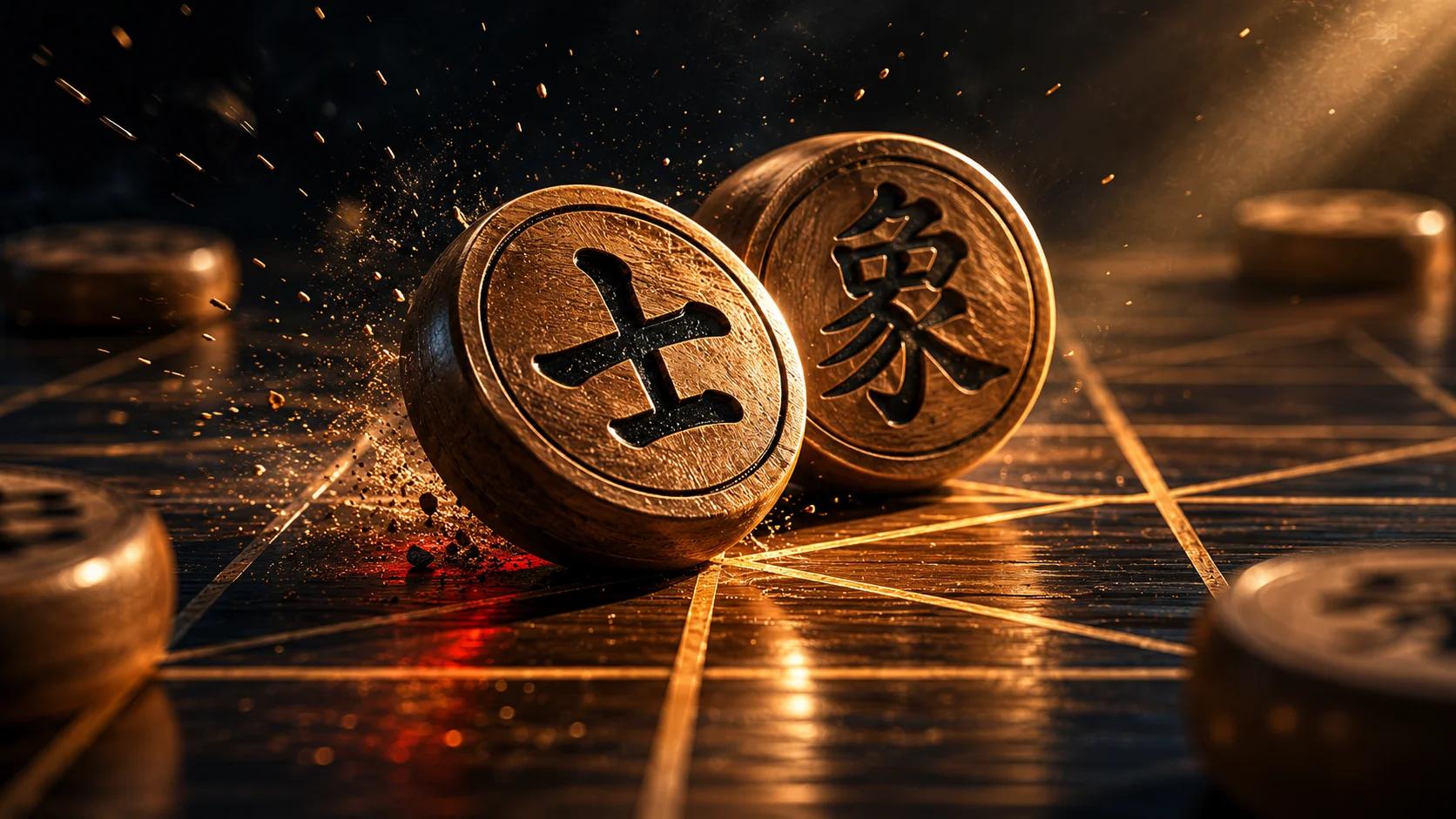
Advisors (士) and Elephants (相/象) are each worth roughly 2 points on the classic piece values scale, far less than a Chariot (9) or a Horse (4). Yet sacrificing them is one of the most powerful tactical resources in Xiangqi. The reason is simple: these pieces often obstruct their own attacking lines. An Advisor blocks the very diagonal an enemy Chariot is trying to penetrate; an Elephant occupies a key intersection that prevents the Cannon from firing or the Horse from leaping. By deliberately removing this obstacle, you pay 2 points to unlock a combination that may be worth a mating attack. The sacrifice is not a gift: it is a calculated tactical investment with a precise expected return.
Opening the Palace with an Advisor Sacrifice
The classic motif is giving up an Advisor to drive your own Chariot deep into the enemy Palace. Picture this position: your Chariot sits on the file of the opposing King, but a Black Advisor blocks the final diagonal approach. If you have a Cannon or a second Chariot in support, you can force an exchange where your Advisor captures the enemy Advisor, or even sacrifices itself outright against a supporting piece. The Palace is suddenly stripped bare and the attack becomes irresistible. This motif sits at the heart of middlegame mastery and appears in countless winning positions. The key is to always have a follow-up piece ready to exploit the breach the instant it opens.
The Elephant Sacrifice to Open a File
An Elephant on the central files, at e3 or e7 depending on side, often blocks the central file aimed at the opposing King. This defensive post becomes a tactical trap in reverse: you cannot fire with your own Cannon, your Chariot is hindered, and the Horse finds no angle. Sacrificing this Elephant — by advancing it to c5 for capture, or trading it against a reachable Pawn — instantly clears the file. The central Cannon can then aim through a screen straight at the enemy King. This sacrifice is especially effective after a Central Cannon opening where pressure on the King's file is already built. Without the clearance, the attack suffocates; with it, the attack explodes into life.
When Should You Sacrifice an Advisor?
Three conditions must be met before sacrificing an Advisor. First, you must gain a critical tempo: your opponent must be forced to capture or react to the sacrificed piece, buying you the move you need to bring a second attacker into play. Second, the attack must follow immediately — if the capturing piece can simply return to defend on the next move, the sacrifice is hollow. Third, your own King's defense must remain sufficient after the offering. Sacrificing an Advisor while an enemy Chariot already prowls your back rank is tactical suicide. These principles echo the ideas covered in our strategy for beginners guide: a sacrifice is only as valuable as what it makes possible afterward.
The Elephant Sacrifice to Free the Horse
The Horse in Xiangqi is notoriously vulnerable to blocking: a single piece on its pivot point makes it immobile. Yet the friendly Elephant often sits precisely on those critical intersections. Sacrificing the Elephant — by advancing it to a square where it will be captured, or trading it against an isolated Pawn — immediately unlocks the Horse's jumps. This motif is devastating when the Horse can then attack an enemy Chariot, create a fork on Advisor and Chariot, or join a wing attack on the King. The math is simple: 2 points of Elephant for the full activation of a 4-point piece that leads a mating attack. To deepen your understanding of the Advisor and Elephant defensive pair, this inverted synergy is essential.
Is an Elephant Sacrifice Always Worth It?
No, and this is where many intermediate players go wrong. An aesthetic sacrifice without concrete calculation is a serious mistake, not a brilliant move. Before offering an Elephant, check three things. Does the attack truly follow? Count the moves until checkmate or net material gain. If you cannot see the continuation, do not sacrifice. Is the defense still viable? A missing Elephant durably weakens one wing. If your opponent still has an active Chariot and Cannon, the counterattack may be lethal. Can the position be won another way? If you are already down material, sacrificing usually accelerates defeat rather than reversing it. The sacrifice is the tool of the player who already holds the initiative, not a lifeline for the drowning.
How Do You Calculate a Sacrifice Step by Step?
Calculating a sacrifice follows a rigorous method. Step 1: identify the target piece (the enemy King, an isolated Chariot, a critical Advisor). Step 2: spot the obstacle (your own Advisor or Elephant blocking the line). Step 3: find the move that removes the obstacle while gaining tempo — usually a forced exchange or a capture demanding a reply. Step 4: visualize the immediate follow-up: which piece exploits the breach? In how many moves? Step 5: check every possible enemy defense, move by move, until resolution. If every branch leads to mate or to a net gain greater than 2 points, the sacrifice is correct. This calculation discipline, detailed in the improvement guide, is what separates winning sacrifices from desperate moves dressed up as brilliance.
The Psychological Side of Sacrifice
An Advisor or Elephant sacrifice destabilizes the opponent psychologically, even when it is technically defensible. The attacked player must abruptly switch from passive defense to concrete calculation under pressure. Many then crack and make a mistake in the rush, even though they would have found the correct defense in calm analysis. This is a real factor in practical play, especially in faster time controls. But beware: relying solely on psychology is a mistake. A sacrifice must be objectively sound first and foremost. The psychological effect is a bonus, never a justification. In the endgame, where calculation becomes more precise and time less pressing, these effects fade — revisit the principles of endgame basics to adjust your judgment accordingly.
Typical Mistakes and Closing Thoughts
Three mistakes appear over and over in failed sacrifices. The aesthetic sacrifice: giving up a piece because the pattern looks elegant, without calculating the concrete continuation. The desperate sacrifice: sacrificing in an already-lost position, hoping for a miracle that never comes. The premature sacrifice: offering the Elephant before the supporting pieces have arrived — the attack suffocates for lack of ammunition. A good sacrifice is cold, calculated, and arrives once every piece is already in place. It is the culmination of a strategy, not its starting point. Train yourself to recognize these motifs by playing on Xiangqi One and exploring the tactics category. Compare your proposed sacrifices to those of an engine or a strong player: confronting your intuition with tactical truth is what produces real progress.