What are the rules of Chinese chess?
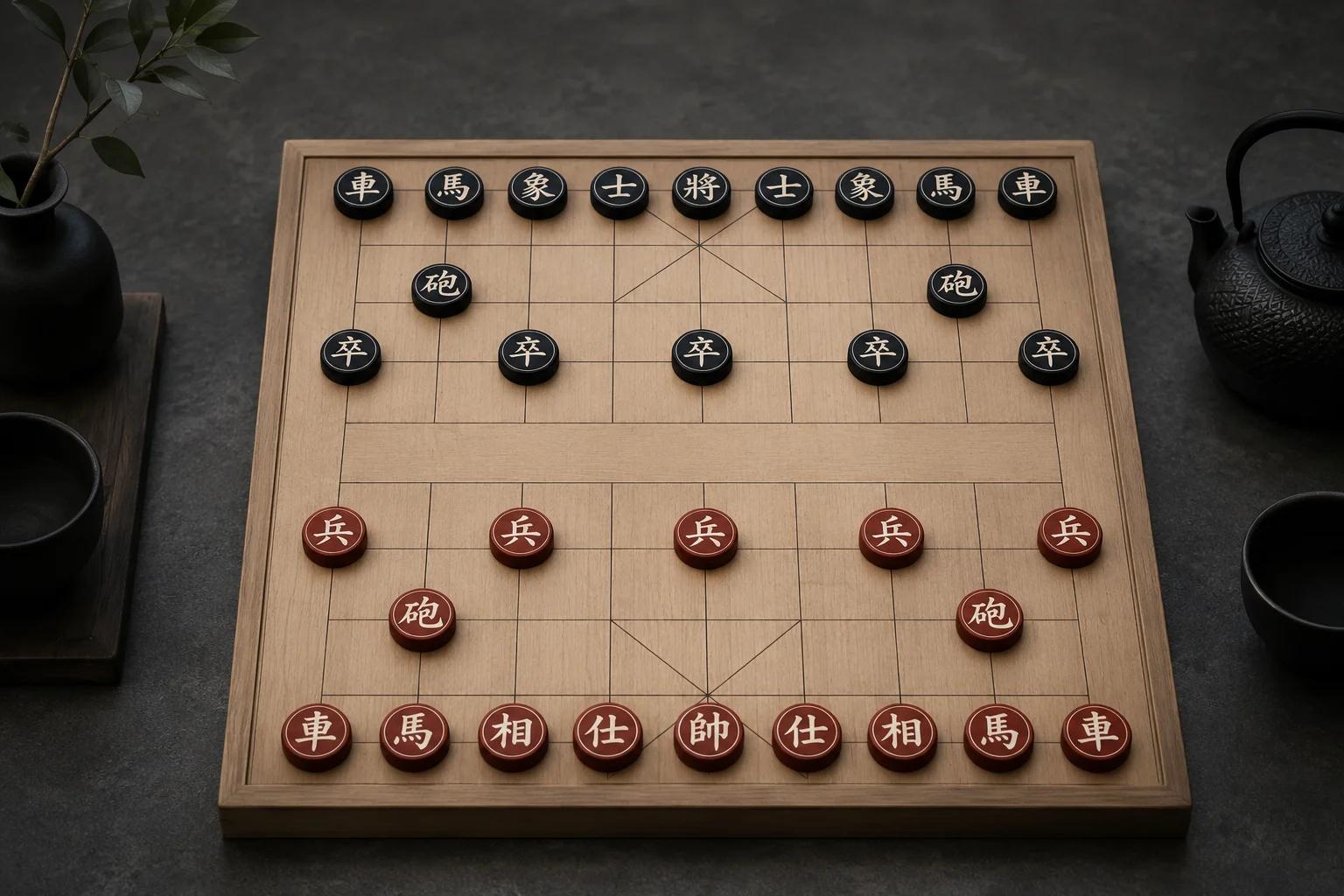
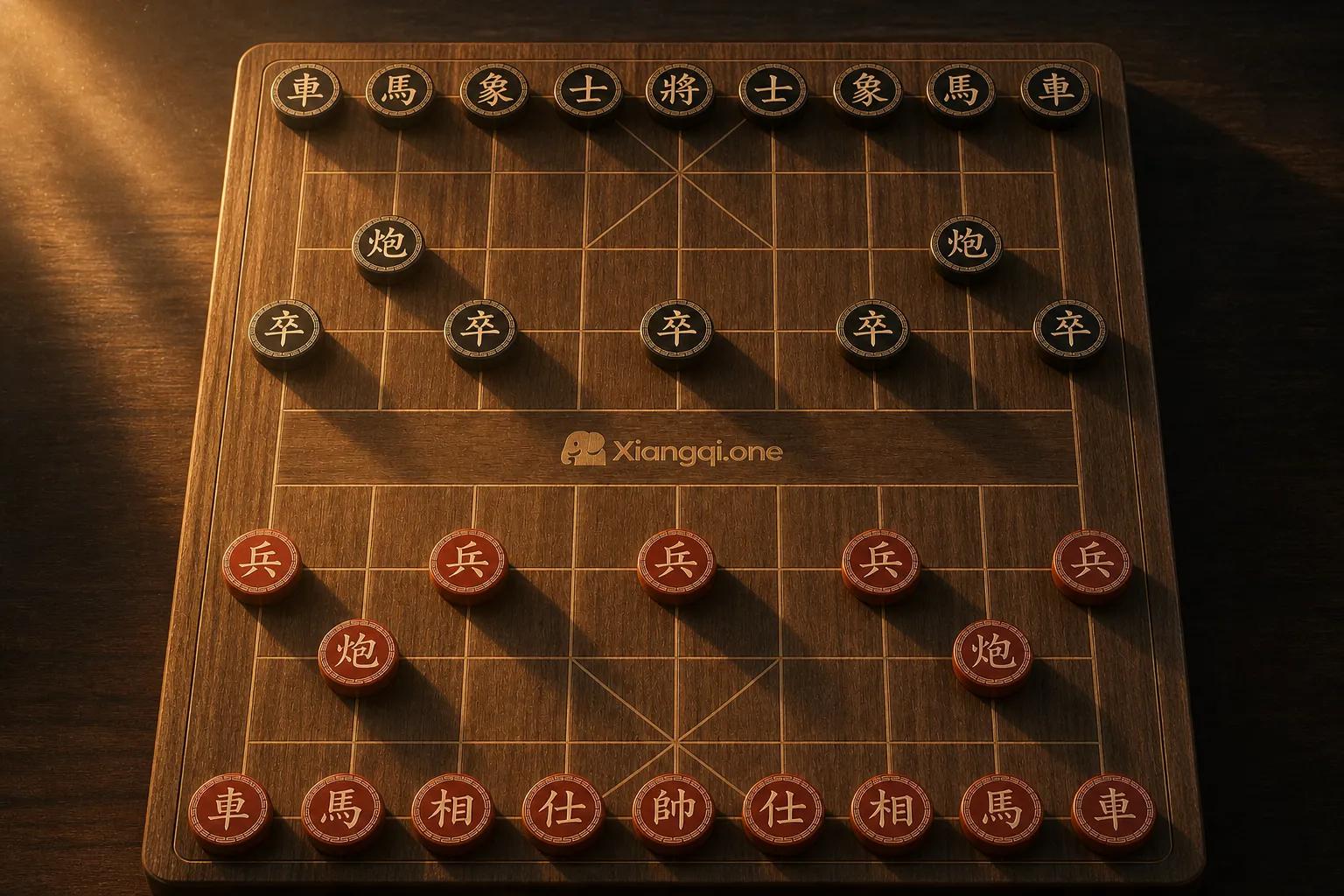
Chinese chess, or Xiangqi, is a two-player game on a board of 9 vertical and 10 horizontal lines, with the pieces standing on the 90 intersections rather than inside squares. Each side has 16 pieces: one General, two Advisors, two Elephants, two Horses, two Chariots, two Cannons and five Soldiers. Red always moves first, then players alternate, one move at a time, with no passing. A move either shifts a piece to an empty point or captures an enemy piece by landing on its point — captured pieces leave the game permanently and never return. You win by checkmating the enemy General, or by leaving your opponent with no legal move at all. Two features of the board constrain movement everywhere: the river across the middle, and the palace, a three-by-three zone at each end. The rest of this page details each rule in turn. If you would rather learn step by step than look a rule up, start with our complete guide to playing Xiangqi.
How does each piece move?
The General moves one point orthogonally and never leaves the palace. The Advisor moves one point diagonally and also never leaves the palace, which restricts it to five points in total. The Elephant moves exactly two points diagonally, cannot cross the river, and is blocked if the single point it passes over is occupied — a situation traditionally called blocking the elephant's eye. The Horse moves one point orthogonally then one point diagonally outward, and is blocked if the orthogonal point it starts through is occupied; this is why a Horse in Xiangqi is far easier to neutralise than a knight in chess, and our complete guide to the Horse develops the consequences. The Chariot moves any distance along a line, exactly like a rook. The Cannon moves like a Chariot when it is not capturing, but to capture it must jump over exactly one piece of either colour, called the screen. The Soldier moves one point forward and never backwards; once it has crossed the river it may also move one point sideways. There is no promotion in Xiangqi.
What do the river and the palace do?
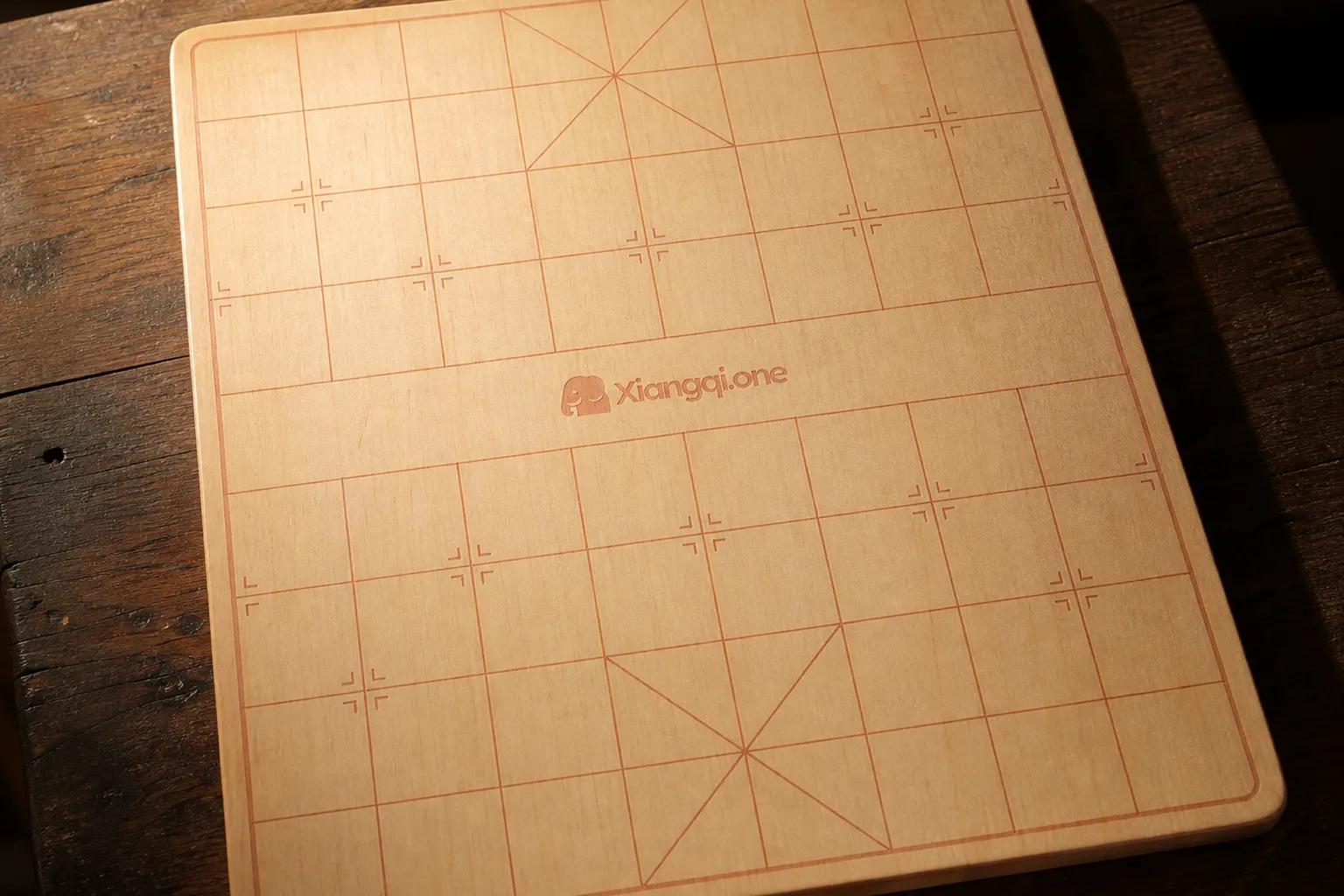
Both are movement constraints drawn onto the board itself. The river is the horizontal gap across the middle. Elephants may never cross it, which permanently confines them to defending their own half — they are purely defensive pieces, unlike chess bishops. Soldiers change behaviour when they cross it, gaining sideways movement, which is why an advanced Soldier is worth far more than one still at home. No other piece is affected by the river. The palace is the three-by-three area at each end of the board, marked with two crossing diagonal lines. The General and the Advisors are confined to it for the entire game and can never step outside, which means attacking the enemy General is a matter of controlling nine specific points rather than hunting a piece across the board. Our guide to the board setup shows exactly where these zones sit relative to the starting position.
How do you win a game of Chinese chess?
There are two ways to win, and the second one surprises chess players. The first is checkmate: the enemy General is under attack and no legal move removes the attack. The second is stalemate, and here Xiangqi reverses the chess convention entirely — a player who has no legal move loses the game. There is no saving yourself by running out of moves, which changes the value of many endgame positions and makes some material-down defences hopeless that would be drawn in chess. A player may also resign at any point, and in tournament play a player can lose on time or through repeated rule infractions. There is no equivalent of a draw by insufficient material as a formal rule, though positions where neither side can force mate are agreed drawn in practice. Our guide to Xiangqi endgame basics covers which material combinations can actually deliver mate.
Which moves are illegal?
Three kinds of move are simply not allowed, and a move that would produce any of them is not a legal option in the first place. You may not leave or place your own General in check — the standard rule, identical to chess. You may not move a piece outside the zone that constrains it: the General and Advisors cannot leave the palace, and Elephants cannot cross the river. And the rule with no chess counterpart: the two Generals may never face each other along a file with no piece between them. If a move would clear the last piece from the file separating the two Generals, that move is illegal. This works in both directions and is a real tactical weapon rather than a curiosity — a defending piece stuck on that file is frozen exactly like a pinned piece, and clearing the file removes escape squares from the enemy General for free. Our complete guide to the General shows how games are won with it.
When is a game of Chinese chess drawn?
Fewer games are drawn in Xiangqi than in chess, partly because stalemate is a loss and partly because the repetition rules are stricter. A game is drawn by mutual agreement, or when neither side has the material to force checkmate — a bare General against a bare General, for instance. Draws also arise when both players are repeating and neither is obliged to vary, which is the ordinary way a balanced position ends. What Xiangqi does not allow is winning a lost position by harassment: a player who repeats a check indefinitely, or who chases the same piece indefinitely, is required to change and loses if they refuse. This is the single biggest rules difference from chess, since a perpetual check in chess is a guaranteed draw. The details are involved enough to deserve their own page — our article on special rules and draws covers perpetual check, perpetual chase and the WXF code in full.
Is there a 50-move rule in Chinese chess?
Yes, but it works differently. The Chinese Xiangqi Association's rulebook contains 自然限着, the natural move limit: 60 moves by each side without a capture make the game a draw. What differs from chess is that it is not automatic — a player has to claim it, the arbiter replays the score sheets to verify, and a claim that proves wrong is penalised. Individual events then add their own tournament-specific limits: many federations apply a cap on total moves, or a lower cap on moves without a capture, after which the game is adjudicated or declared drawn, and the exact figure depends on the ruleset in force. The World Xiangqi Federation, the Chinese Xiangqi Association and the various online platforms do not all use identical thresholds, so a rule you learned on one platform may not apply on another. In casual play this almost never comes up, because the repetition rules resolve most endless positions long before a move count would. If you play in rated competition, check the ruleset of the specific event rather than assuming — the WXF publishes its own code.
How do the rules differ from Western chess?
Six differences matter in practice. Pieces sit on intersections, not in squares, which gives 90 points instead of 64. The Cannon captures by jumping a screen piece, a mechanic with no chess equivalent at all. The Horse can be blocked, so it is not the leaping piece a knight is. Elephants and Advisors are locked to their own half or their own palace, so both armies keep permanent defenders that can never join an attack. Stalemate is a loss, not a draw. And perpetual check is forbidden rather than being a drawing resource. There is no castling, no en passant, no promotion, and no two-square first move for Soldiers. If you are coming from chess, the pieces that will mislead you most are the Cannon, which you have no intuition for, and the Horse, which looks familiar but is not — our guide for chess players works through each of these in order.
Which rules do beginners get wrong most often?
Four, consistently. Forgetting that the Cannon needs a screen to capture but not to move — beginners either try to capture along an empty line or refuse to move the piece at all. Forgetting that the Horse can be blocked, and calculating a knight-style leap that is not legal. Assuming that stalemate is a draw, and defending a lost endgame in a way that loses immediately instead. And missing the facing-Generals rule in both directions: not seeing that an escape square is illegal, and not seeing that an enemy defender is frozen on the file. The first three cost material, the fourth costs whole games. Our article on common beginner mistakes covers these alongside the strategic habits that hold new players back, and our complete guide to the Cannon is worth reading in full given how alien the screen mechanic is.
Checking a rule quickly, and putting them into practice
Rules stop being something you look up once you have played a few dozen games, because almost every rule on this page exists to make a specific tactic possible. The screen rule is what makes Cannon mates work; the palace restriction is what makes those mates findable; the facing-Generals rule is what makes them forced. Reading about them separately makes them feel like a list of exceptions, and playing makes them feel like one coherent system. The fastest route is to play against an opponent calibrated to your level, so mistakes come often enough to teach you something — open Xiangqi One to start from the standard position right now. For the pieces one by one, continue with our complete guide to the Xiangqi pieces, and for everything about the board itself, our board setup guide. The rest of the fundamentals live in the rules category. The Soldier repays a closer look, since its behaviour changes completely at the river — our complete guide to the Soldier covers the crossed and uncrossed cases.