What does a Xiangqi board look like?
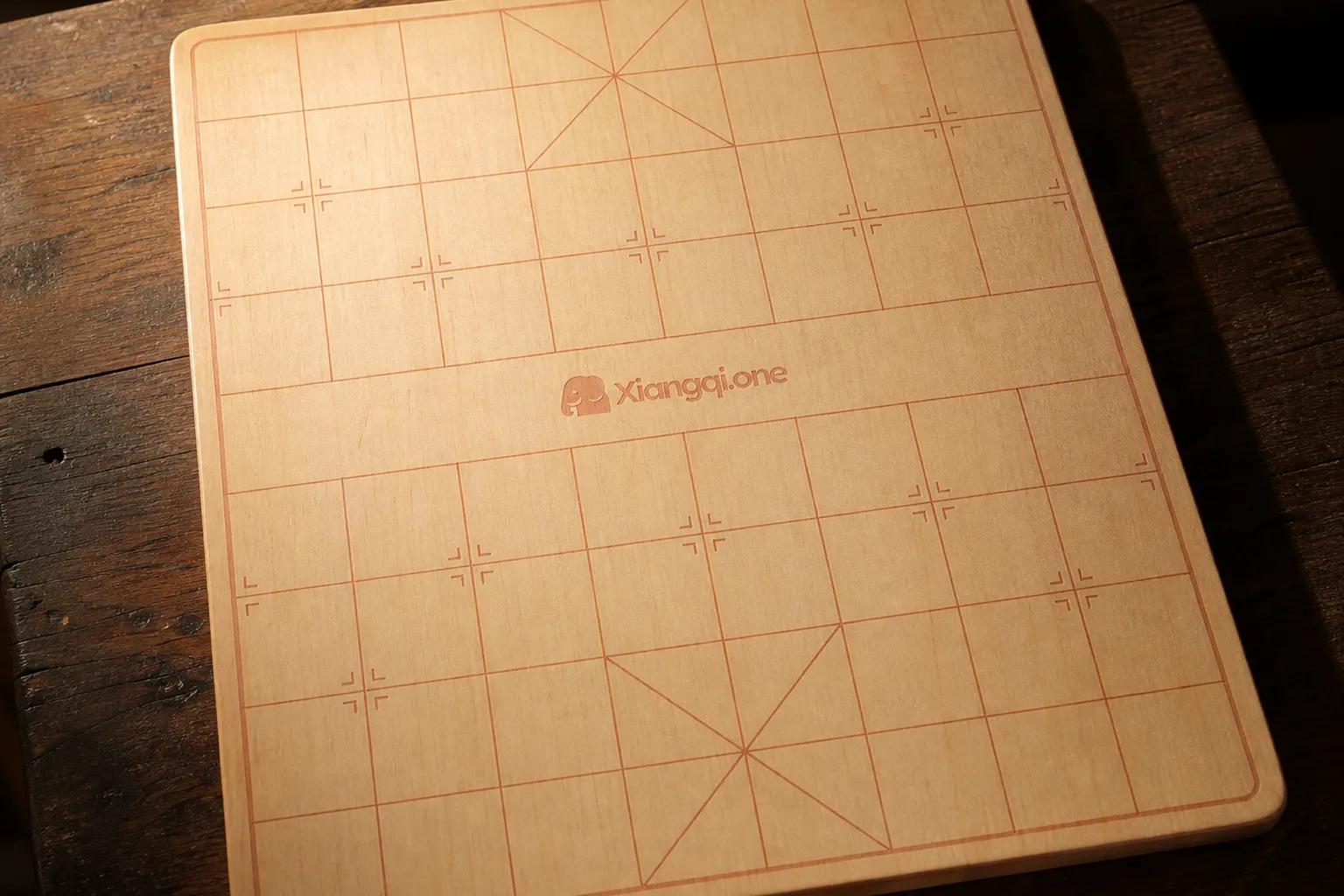
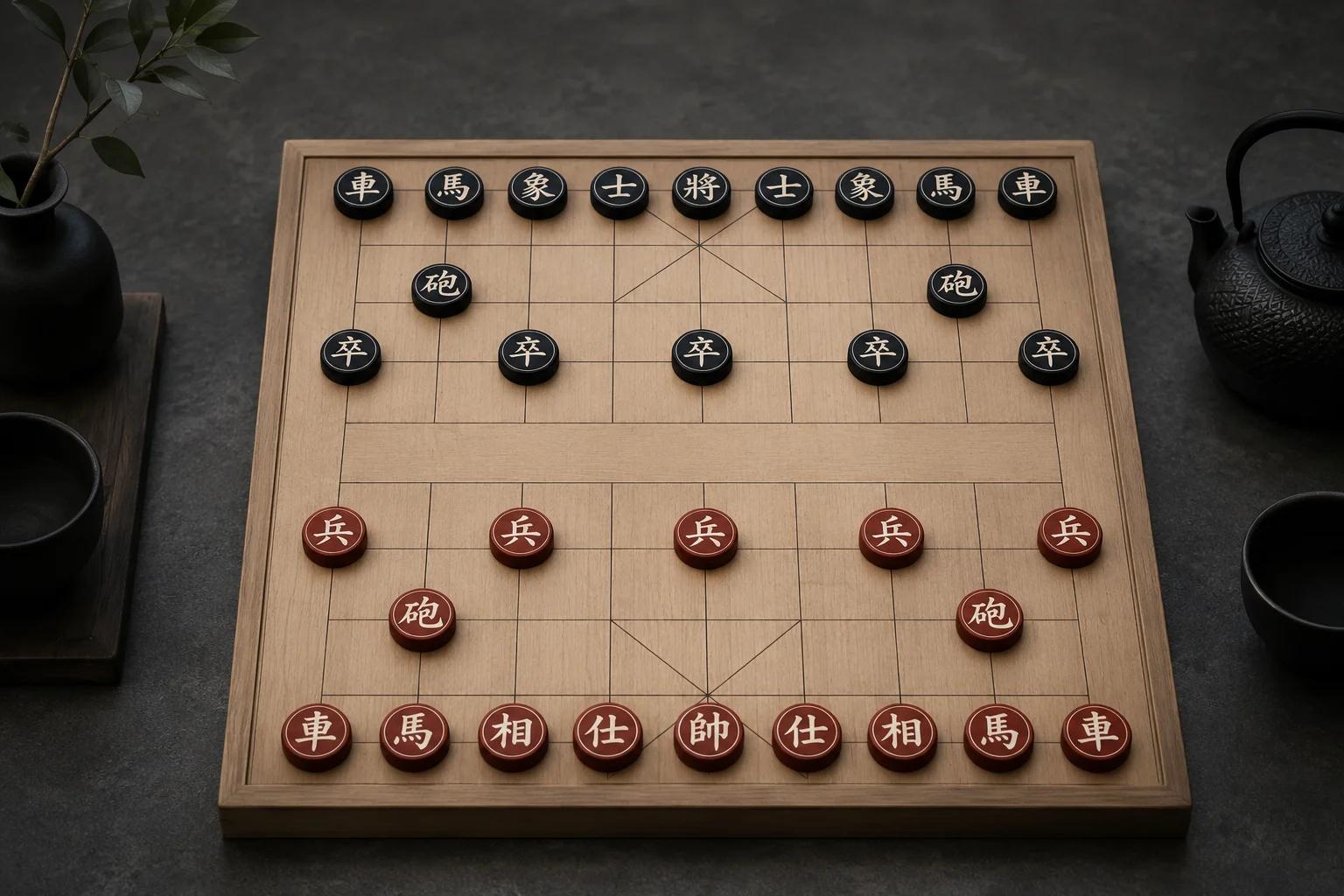
A Xiangqi board is a grid of 9 vertical lines and 10 horizontal lines, which gives 90 playable points. It is taller than it is wide, and noticeably different from a chessboard at first glance because the pieces do not sit inside squares. Two features have no chess equivalent. The river is the horizontal gap running across the middle of the board, between the fifth and sixth horizontal lines; it is usually marked with Chinese characters and it is not decoration, because it changes how Elephants and Soldiers behave. The palace is the three-by-three area at each end, marked with two crossing diagonal lines, occupying the three central files; the General and the Advisors never leave it. Everything about the starting position follows the symmetry of these features. For the rules that govern movement once the board is set, our complete guide to playing Xiangqi covers them from the first move.
Where does each piece start?
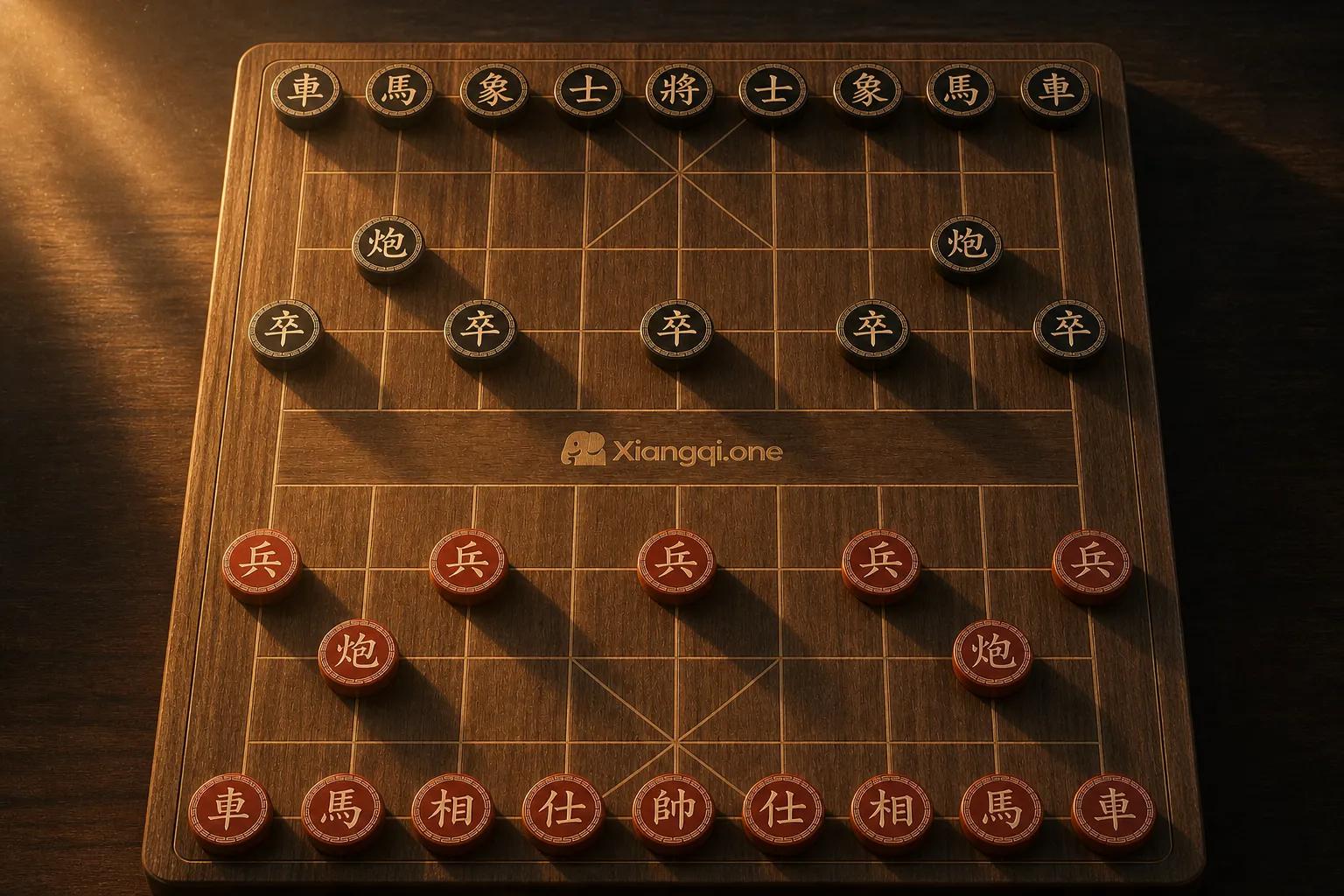
Each player has 16 pieces, arranged symmetrically on three lines. Number the vertical lines 1 to 9 from your left. On your back line, from left to right: Chariot, Horse, Elephant, Advisor, General, Advisor, Elephant, Horse, Chariot. The General sits on line 5, exactly in the middle of the palace's back edge, with an Advisor on each side. On the third line from you, place your two Cannons on lines 2 and 8 — that is, directly in front of the two Horses, two lines in from each edge. On the fourth line, place your five Soldiers on lines 1, 3, 5, 7 and 9, so they alternate with empty points. Your opponent mirrors this exactly. The second and fifth lines start empty, which is why the board looks open even with 32 pieces on it. If a piece does not have a marked point under it and it is not on the back line, something is wrong.
Why do pieces sit on intersections instead of squares?
Because the lines, not the cells, are what the pieces travel along. In chess a rook occupies a square and slides across other squares; in Xiangqi a Chariot occupies a point where two lines cross and slides along one of those lines. The practical consequence is that the board has 90 points rather than the 72 cells you would count if you thought in squares, so there is more room than the board's size suggests. This also explains the palace's diagonal lines: they are not decoration marking a zone, they are the actual paths the Advisors travel, which is why an Advisor moves diagonally and only within those four segments. If you come from chess, this is the single adjustment that makes everything else click — our guide for chess players covers the rest of the mental switches. For how each piece then moves, see our complete guide to the Xiangqi pieces.
Which Chinese character goes on which piece?
This is where physical sets confuse newcomers, because Red and Black use different characters for the same piece. Red uses 帥 for the General, 仕 for the Advisor, 相 for the Elephant and 兵 for the Soldier; Black uses 將, 士, 象 and 卒 respectively. The pieces are identical in how they move — only the writing differs, a convention inherited from the game's military symbolism. Many traditional sets also distinguish the other three: Red gets 俥, 傌 and 炮 where Black gets 車, 馬 and 砲, though plenty of modern sets use the same character on both sides for these. So if you open a set and find what look like fourteen different piece types instead of seven, nothing is wrong — pair them by shape and position, not by character. The one pair worth memorising early is 相 and 象, since Elephant placement is the mistake beginners make most often.
Which side is yours, and who moves first?
Red always moves first, the equivalent of White in chess. Red is conventionally shown at the bottom of the board in diagrams and on screen, so if you are playing Red you are looking at your own pieces on the near side, with the river between you and your opponent. There is no fixed physical rule about which end of a wooden board is Red's — the board is symmetrical, so you simply agree and set up. What does matter is that the General is on line 5 from either player's own left, which means the two Generals face each other down the same central line at the start. That is not accidental: it is the origin of the flying general rule, which forbids the two Generals from ever seeing each other along an empty line. Our complete guide to the General explains why that constraint decides so many games.
What are the river and the palace for?
Both are movement constraints written into the board itself. The river does two things: Elephants may never cross it, which permanently limits them to defending their own half, and Soldiers change behaviour when they cross it, gaining the ability to move sideways as well as forward. A Soldier that has not crossed can only push straight ahead, one point at a time, and never retreats at any stage. The palace confines the General and the Advisors for the entire game, which is why attacking the palace is a matter of controlling nine specific points rather than chasing a piece across the board. Neither feature has a chess counterpart, and both are the reason material counts translate badly between the two games — the relative worth of each piece is covered in our article on Xiangqi piece values.
What are the small crosses marked on the board?
Most boards mark a handful of points with small right-angle brackets. These are position markers, not special squares: they simply show where the Cannons and Soldiers begin, so you can set up quickly without counting lines. There are usually seven marked points per side — two for the Cannons on the third line and five for the Soldiers on the fourth, with the pattern mirrored across the river. They confer no rule of any kind: a piece standing on one has no special status, and moving through one costs nothing. If your board has them, use them as a checklist when setting up. If your board does not have them, count instead: Cannons on lines 2 and 8 of the third line, Soldiers on the odd-numbered lines of the fourth.
What are the most common setup mistakes?
Four, and they are easy to catch once you know them. The first is swapping the Advisors and the Elephants on the back line: the order outward from the General is Advisor, then Elephant, then Horse, then Chariot. Reverse the first two and the palace defence is wrong from move one. The second is putting the Cannons on the second line instead of the third, usually by placing them directly behind the Horses rather than two lines forward. The third is spacing the Soldiers wrongly — they go on alternating points, five in total, not on five adjacent ones. The fourth, on physical sets, is mixing up 相 and 象 and building a position with three Elephants on one side. A quick check that catches all four: every piece except the back line should be standing on a marked point, and each side should show exactly five Soldiers and two Cannons. Our article on common beginner mistakes covers the errors that come after the setup.
Setting up on a screen, and what to do next
Online you never set up anything, which removes the errors above but also removes the repetition that teaches you the position. It is worth arranging a physical board a few times even if you play entirely online, because knowing the starting square of every piece from memory is what lets you read notation fluently later — our guide to Xiangqi notation builds directly on the line numbering used in this article. Once the board is set, the fastest way forward is to play: the opening principles that follow from this exact position are covered in our guide to Xiangqi openings, and the classic first move for Red is explained in our article on the central cannon opening. To start a game from the standard position right now against an opponent at your level, open Xiangqi One, or browse the rules category for the rest of the fundamentals.